
Toy Warehouse
Company
Shop By Category
T&Cs
Shop Online
  • Box contents listed
  • Free tracked USA-wide delivery over $100
  • 14-day returns

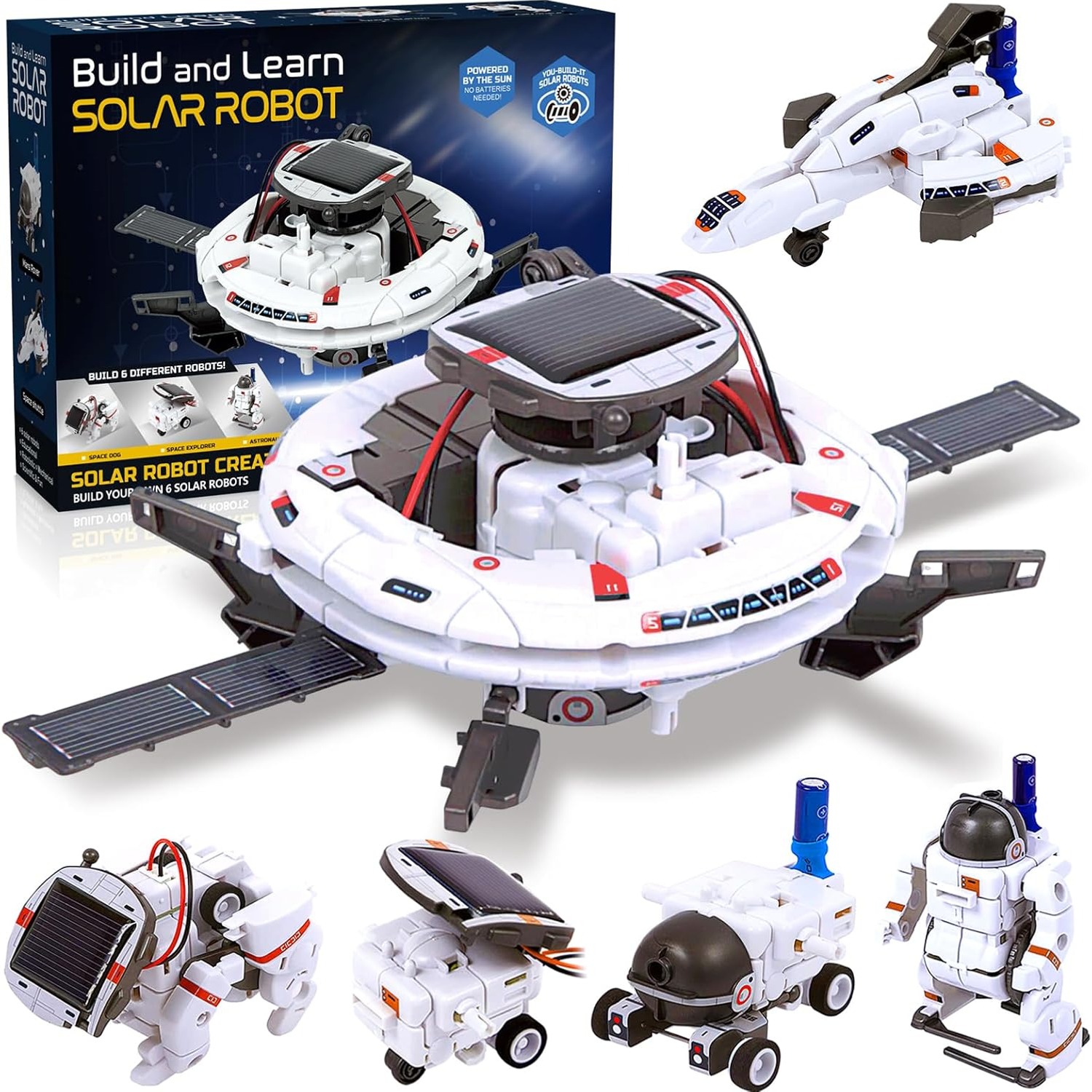
6 in 1 Solar Robot Kit | Solar robot building kit | STEM building set

6-in-1 Solar Robot Kit

$43.99 $52.99 Save $9
  • Runs On Sunlight
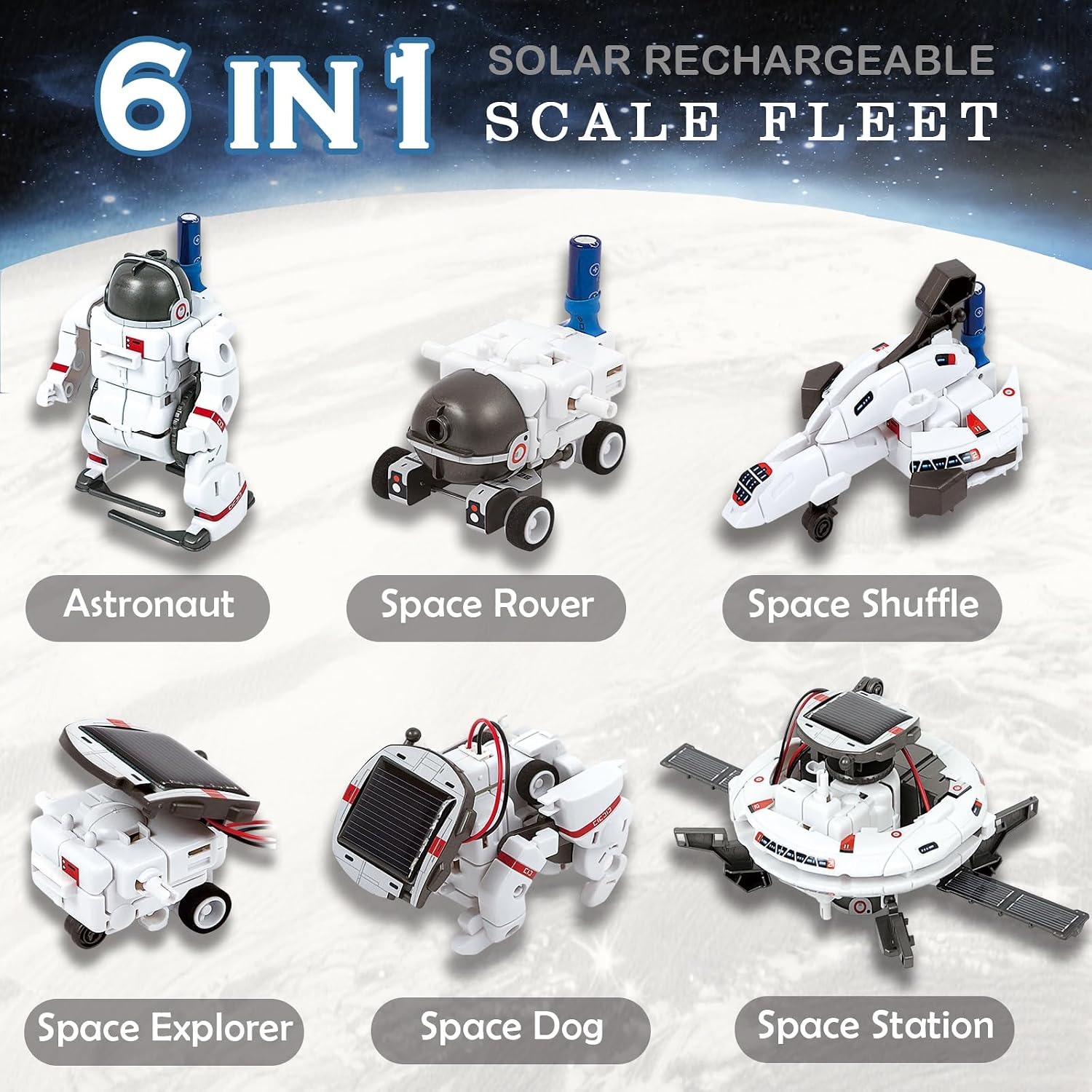
  • Six Builds In One
  • Dual Power Options
  • Guided Instructions

Price: $43.99 $52.99

  • Free tracked USA-wide delivery on orders $100+, otherwise a flat $15
  • Pay by card or PayPal, handled by the payment provider
  • 14 days to change your mind, plus your statutory rights
Product specifications
BrandHechify
Set Name6-in-1 Solar Robot Building Kit
Model Number219A
Manufacturer Part Number2666
ManufacturerSHANTOU CITY BLOCK SCIENCE & EDUCATIONAL TOYS CO., LTD
Recommended Age8 years and up
Age Range DescriptionKid
Educational ObjectiveSTEM, creative skills, exploratory skills
ThemeSTEM solar robot toy
SubjectClassic
Included ComponentsSTEM solar robot toy
Number Of Items1
Unit Count6 count
Material TypePlastic
Battery DescriptionAlkaline
Item Dimensions2.55 x 9.37 x 7.09 inches
Item Weight0.29 kg
Weight0.29 kg
Shipping & returns

Tracked delivery anywhere in the USA. It is free on orders of $100 or more, and a flat $15 below that.

If it is not right for you, send it back within 14 days of delivery in resaleable condition and we refund the price you paid, including standard delivery. That is a voluntary policy we offer on top of your legal rights. You cover the cost of returning it unless the item is faulty.

If it arrives faulty, damaged or not as described, we put it right at no cost to you under the consumer protection law of your state and the Federal Trade Commission Act, return postage included.

Shipping details · Refunds and returns

Runs On SunlightThe solar panel drives the motor whenever there is decent light outdoors.
Six Builds In OneTake one model apart and reassemble the pieces into the next design.
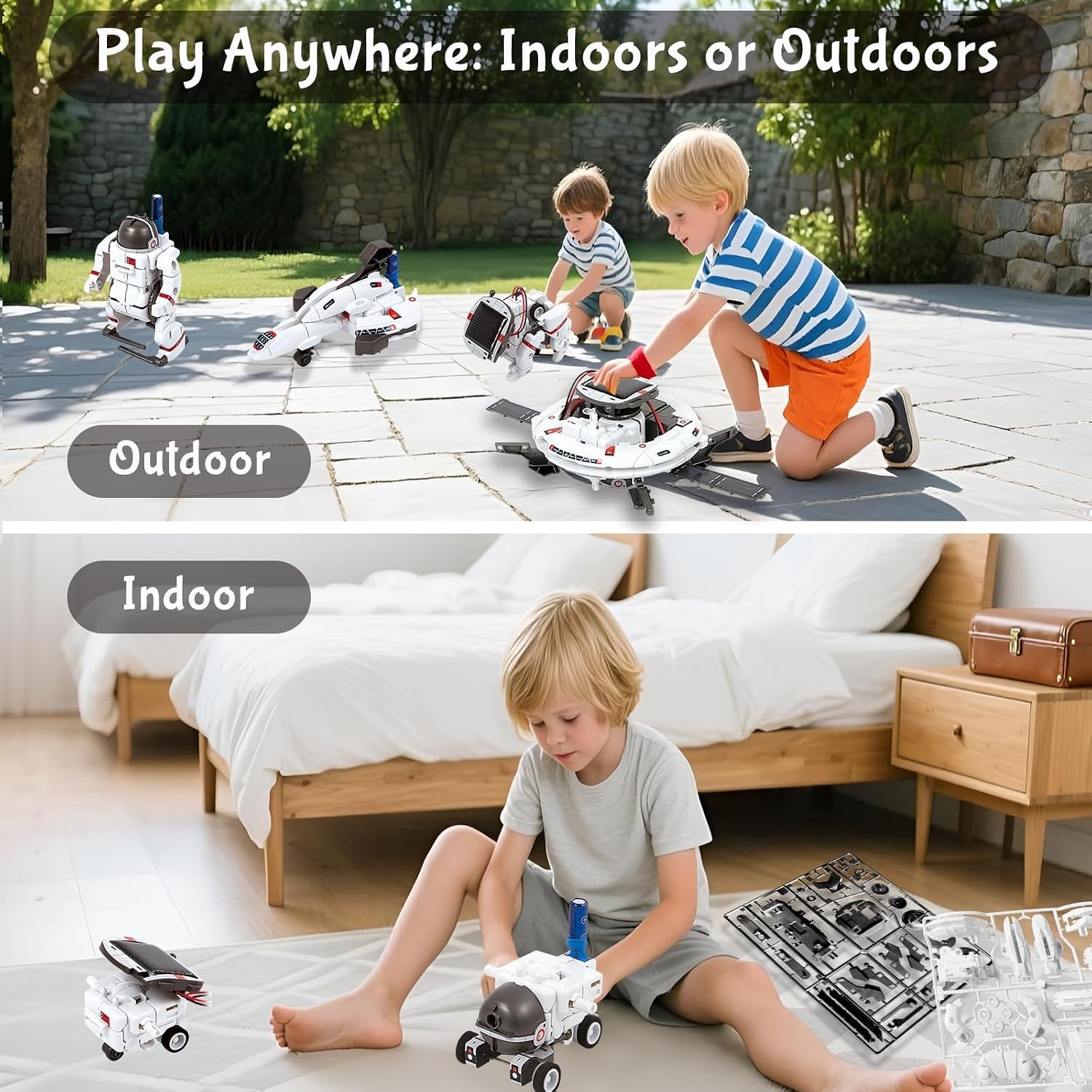
Dual Power OptionsSwitch to battery power for cloudy days and indoor play.
Guided InstructionsA step-by-step manual walks builders through each robot in order.

Turn a quiet afternoon into a hands-on science session with a 6 in 1 solar robot kit that moves when the sun hits it.

Six buildable robots, a dual power setup (solar plus battery), and a step-by-step manual that teaches energy conversion while kids snap the parts together.

One box of parts rebuilds into six different robots, so the fun does not end with the first build.

A solar panel converts light into motion, giving kids a clear, visible lesson in clean energy.

The dual power setup means play can continue indoors or on overcast days using alkaline battery power.

The manufacturer recommends it for ages 8 and up, which lines up with the fine motor work and reading involved.

It makes a tidy birthday or holiday gift for a child who likes taking things apart and figuring out how they work.

6-in-1 Solar Robot Kit

This is a build-it-yourself robot set that runs on light. Inside the box are plastic parts, a small motor, and a solar panel. Kids follow the printed manual to put the pieces together, carry the finished robot into the sun, and watch it start moving on its own. There is no app, no pairing, and no screen involved. The sun does the work, and the child does the engineering.

6-in-1 Solar Robot Kit

The "6 in 1" part is what gives the kit its staying power. The same set of components can be assembled into six different robot designs. When a child gets bored of one, they strip it back down to parts and build the next. That cycle of disassembly and reassembly is where most of the learning happens, because the second and third builds force kids to think about how the pieces relate to each other rather than just copying pictures.

6-in-1 Solar Robot Kit

A dual power setup makes the kit practical year round. On a bright day, the solar panel supplies the energy. When the weather turns or play moves to the kitchen table, alkaline battery power takes over. Switching between the two is a natural way to talk about where energy comes from, how it gets converted into movement, and why a cloudy sky slows things down.

6-in-1 Solar Robot Kit

The manufacturer recommends this kit for ages 8 and up. That age guidance fits the task. There is small-part handling, a bit of reading, and some patience required when a connection does not seat properly the first time. Younger children can absolutely join in, but they will want an adult or older sibling nearby for the trickier steps.

6-in-1 Solar Robot Kit

As a gift it sits in a useful spot. It is substantial enough to feel like a real present, it keeps a child busy for more than one sitting, and it leaves something behind afterwards. Teachers and after-school clubs use kits like this for the same reason, because a working model that moves in sunlight makes an abstract idea concrete in about thirty seconds.

Not sure yet? That is fine.

A toy has to suit the child it is for, and you cannot always judge that from a photograph. If it is not right for you, send it back within 14 days of delivery in resaleable condition and we refund the price you paid, including standard delivery. That is a voluntary policy we offer on top of your legal rights.

If it turns up faulty, damaged or not as described, that is on us. The consumer protection law of your state covers you, and we pay the return postage. Read the full detail on our refunds and returns page, or ask us anything before you order.

Frequently Asked Questions

What exactly is in this kit?

It contains the plastic parts, motor, and solar panel needed to build a solar-powered robot, plus a step-by-step user manual. The maker describes the included components as a STEM solar robot toy with a unit count of 6. The six refers to the six different robot designs you can build from the one set of parts.

How does the solar part actually work?

The small panel on the robot collects light and converts it into electrical current, which turns the motor. The motor then drives the gears and legs or wheels, depending on which model is built. It is a direct, visible chain of cause and effect, which is exactly what makes it a good teaching toy.

Does it need direct sunlight?

Bright, direct sun gives the strongest and most reliable movement. Weaker light will usually produce slower or stop-start motion. If you are testing it indoors near a window on a dull day, expect less movement than you would get outside at midday.

Can it be used indoors?

Yes. The kit has a dual power setup, so when the light is poor you can switch to battery power and keep playing. The battery description listed is alkaline. That flexibility is one of the reasons this works as a best rainy day building kit rather than a summer-only toy.

Are batteries included?

Battery inclusion is not specified by the maker. The battery description given is alkaline, so plan on having suitable alkaline batteries on hand just in case. Check the packaging when the kit arrives.

What age is this suitable for?

The manufacturer recommends 8 years and up. That reflects the small parts, the reading in the manual, and the fine motor control needed to seat pieces properly. Younger kids can take part with help from an adult.

Is it too easy for a 12 year old?

Most 12 year olds will handle the first build comfortably, but the six-model format keeps it interesting because later designs are more involved. Older kids also tend to get more out of the energy conversion side of it. It is frequently chosen as one of the best science kits for kids age 8-12 for that reason.

How long does one robot take to build?

It varies with age and experience, but a single model commonly takes somewhere between thirty minutes and a couple of hours. The first build is always the slowest because the child is still learning how the parts connect. By the third model, assembly moves much faster.

Can you build more than one robot at a time?

No. There is one set of parts, so you build one design, play with it, then take it apart to build the next. That reuse is the point of the kit and it is what makes it a best 6 in 1 robot kit rather than a single-model toy.

What are the six robots?

The manual walks through six different designs that can all be made from the same components. Exact model names are not specified by the maker. The instruction booklet in the box lists them in order with diagrams for each.

What is it made of?

The material type listed is plastic. Specific plastic types and color are not specified by the maker. The solar panel and motor are the only non-plastic functional parts.

What size is the finished robot?

The item dimensions given are 2.55 x 9.37 x 7.09 inches, which describes the packaged product. Finished robot size varies between the six designs, since some models are tall and upright while others sit low and wide.

How heavy is it?

Item weight is 0.29 kg, so it is light and easy for a child to carry outside and reposition in the sun. It also means shipping is straightforward and the box is easy to wrap as a gift.

Do I need tools to build it?

Most parts in kits like this are designed to press or clip together by hand. If a small screwdriver is required for the motor housing, it would be noted in the manual. Nothing beyond basic household tools would be needed.

Is any glue needed?

No glue should be required, because the robots are designed to be taken apart and rebuilt. Gluing anything would defeat the purpose of the six-model format. Keep the connections dry and friction-fit.

Will an adult need to help?

Children at the lower end of the age range often appreciate a hand with the fiddly first steps and with reading diagrams. Many parents enjoy sitting in on the first build anyway. After that, most kids want to do it themselves.

Is this good for a classroom?

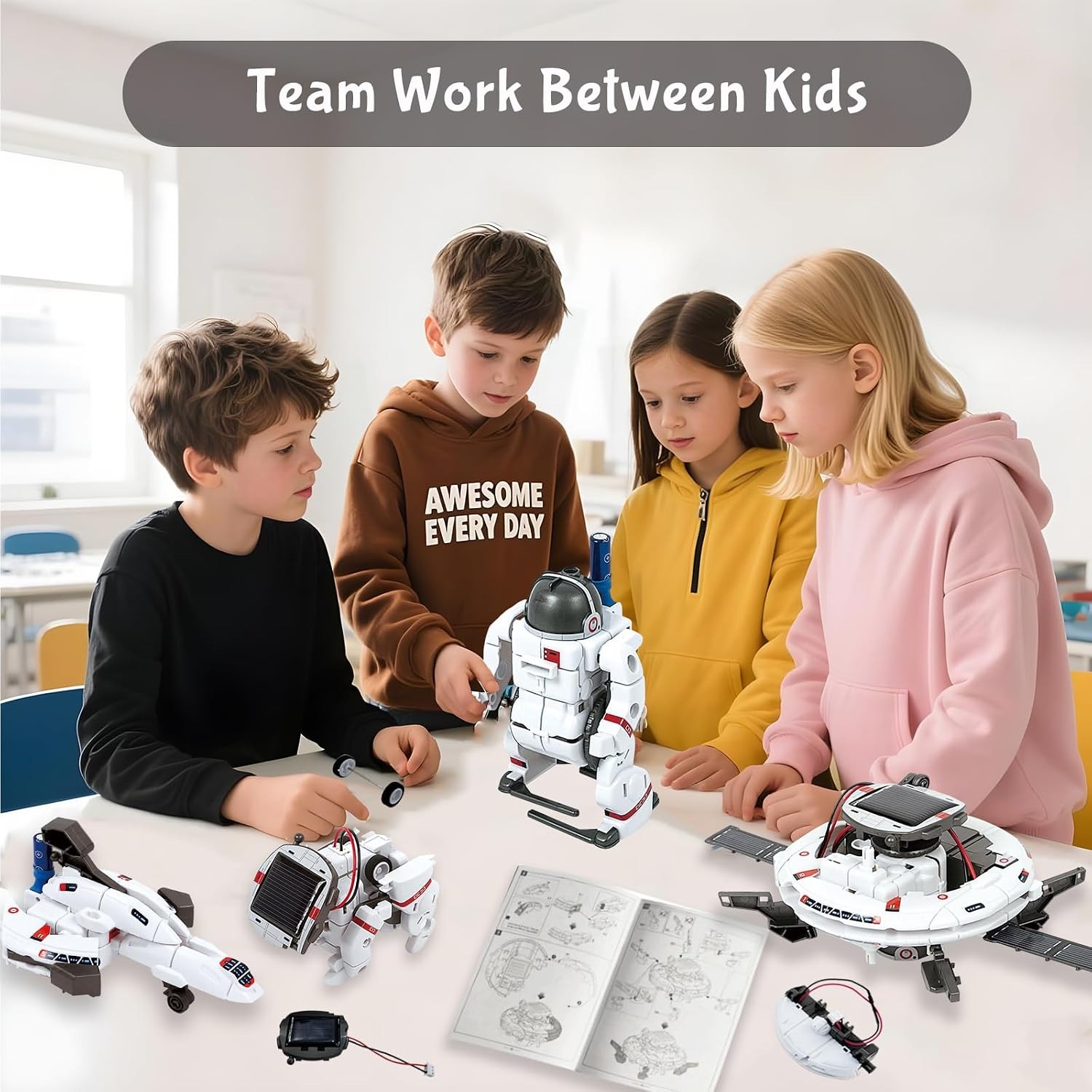
Yes, it works well for a small group project or a science club session. The stated educational objectives are STEM, creative skills, and exploratory skills. One kit between two or three students makes a reasonable best classroom science kit setup for a single lesson.

What does it teach?

It covers energy conversion, basic mechanics, gearing, and assembly logic. Watching a robot start moving the moment it hits sunlight makes the idea of clean energy concrete in a way a diagram cannot. It also builds patience and sequencing skills.

Is this suitable for girls and boys?

Absolutely. There is nothing gendered about building a robot or learning how a solar panel works. It is routinely picked as a best STEM gift for girls and a best STEM gift for boys in the same age band.

How do I clean it?

Wipe the plastic with a dry or barely damp cloth. Keep the solar panel clean, because dust and fingerprints reduce how much light it picks up. Avoid soaking any part of the robot.

Is it waterproof?

No. It contains a motor and a solar panel, so keep it out of rain, puddles, and sandpits. Outdoor play on a dry patio, path, or table is ideal.

What if a part goes missing?

Keeping all the pieces in one lidded box or zip bag between builds prevents most losses. If something does go missing, contact us with the model number 219A and a description of the part and we will advise on options.

Can the robot be left outside?

It is better to bring it in after play. Leaving it outdoors exposes it to weather, temperature swings, and UV, none of which do plastic or a small motor any favours. A few minutes of tidying up protects the kit for years.

Does it make noise?

Small motorised toys produce a light whirring sound while running. It is not loud and it stops the moment the robot leaves the light or is switched off. That makes it one of the better options for a best screen free activity for kids indoors.

Is this better than a programmable robot?

It is a different thing. A programmable robot teaches code, while this teaches mechanics and energy. For a child who has not built anything mechanical before, this is a gentler and cheaper starting point, and a solid best beginner engineering toy.

Will it hold a child's attention?

The six-model format gives you six separate sittings instead of one. Kids who enjoy building generally return to it, and many invent their own variations once they understand how the parts fit. Children who dislike instructions may need some encouragement for the first build.

Is it a good birthday present?

It is a common pick for a best birthday gift for a 10 year old because it feels substantial, it is screen free, and it leaves something behind. The box is a tidy size to wrap. Pair it with a pack of alkaline batteries to be safe.

How is it packaged and shipped?

It ships in its retail box at 0.29 kg, which keeps handling simple. Items are dispatched from our fulfilment partners to your delivery address. You will receive tracking details once the order is on its way.

What is the returns policy?

You have 14 days from delivery to return it for a change of mind, provided it is unused, complete and in its original packaging. Return shipping is yours to pay. If it arrives faulty or damaged, tell us and we will put it right at no cost to you.

What if it is not right for my child?

If the kit turns out to be too advanced, too simple, or just not their thing, contact us and we will talk through your options. An unopened kit can usually be returned under our standard policy. If it has been opened, tell us what did not work and we can suggest something better suited, whether that is a simpler build or a more advanced set.

How To Choose A Solar Robot Kit That Actually Gets Built

6 min read Toy Warehouse

The toy that gets built once and then forgotten

Most parents know the pattern. A building set comes out at a birthday, the child builds the thing on the box, it sits on a shelf for a week, and then it joins the pile. The problem is not the child. It is that a lot of kits only have one outcome. Once you have built it, there is nothing left to discover.

A 6 in 1 solar robot kit works differently because the finished model is never really finished. The same handful of parts becomes a different robot each time, and the thing that makes it move is sunlight rather than a switch. That second detail matters more than it sounds. A toy that runs on a battery is just a toy. A toy that stops when a cloud passes over and starts again when the sun returns is a demonstration, and kids notice.

How a solar robot actually works

The mechanics here are simple enough that an eight year old can follow them. A small photovoltaic panel sits on the robot. When light hits the panel, it produces a small electrical current. That current feeds a motor. The motor spins, the spin is passed through gears, and the gears move legs or wheels.

Nothing is hidden. There is no circuit board doing something mysterious. A child can put a hand over the panel and watch the robot stop, then lift the hand and watch it go again. That direct link between cause and effect is why these kits show up on so many school science lists. You cannot really argue with a robot that walks when the sun is out.

This particular set also includes a second power option. On a dull day or indoors, alkaline battery power takes over. That might sound like a compromise, but it is genuinely useful as a teaching point. You can run the same robot both ways and talk about where the energy came from in each case. One source runs out and needs replacing. The other does not.

Who this suits

The manufacturer recommends ages 8 and up, and that is a sensible line. Below eight, the small parts and the diagram-reading usually need an adult sitting alongside. That is not a bad thing, but it changes it from an independent activity into a shared one. Plan accordingly.

Between eight and twelve is the sweet spot. Kids in that range have the hand control to press parts together properly, the reading ability to follow a manual, and enough patience to work through a build that does not go right the first time. They also start asking the kind of questions the kit is designed to answer, like why the robot is slower in the morning than at noon.

Older children and teenagers can still get something from it, particularly if they go off-script and start modifying the designs. The manual gives six builds, but there is no rule saying you have to stop there.

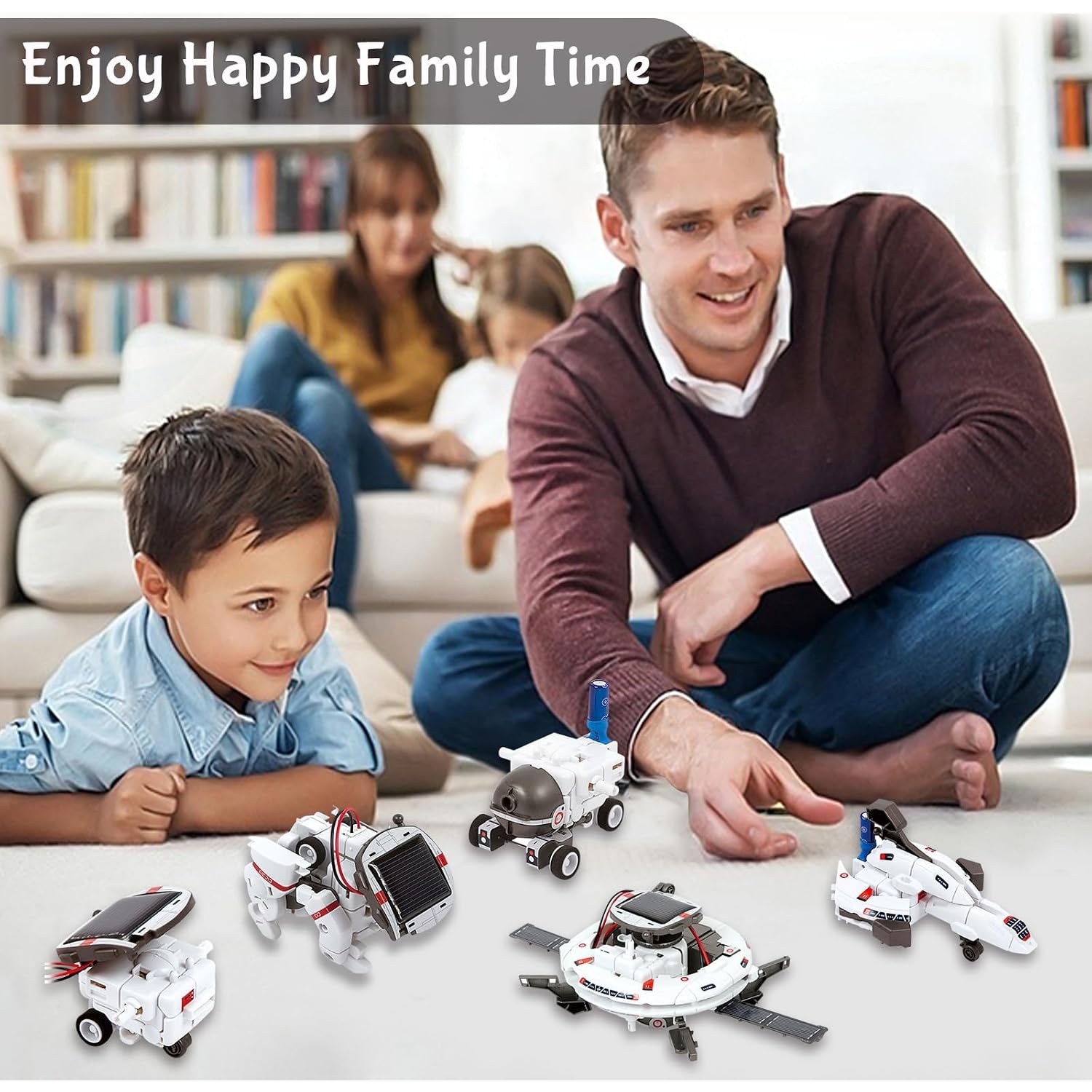
It also works for adults who want a shared project with a child. Building something together on a Saturday morning, then taking it into the garden to test, is a decent way to spend an hour. A lot of people searching for the best screen free activity for kids end up somewhere like this.

What to look for when comparing kits

Not all solar building sets are equal, and the differences are worth knowing before you buy anything.

Count the real builds. A kit that advertises six models should genuinely rebuild into six working designs, not six cosmetic variations of the same chassis. Check whether the designs move differently, because that is where the learning sits.

Check the power options. Solar-only kits are cheaper but they are hostage to the weather. If you live somewhere with long gray winters, a solar-only robot spends half the year in a closet. Dual power, solar plus battery, keeps the kit usable year round.

Look at the age guidance honestly. Manufacturers set age ratings for a reason, and small parts are the usual driver. A kit rated 8 and up given to a five year old is a frustration for the child and a hazard risk for the parent.

Think about part storage. Kits that get rebuilt need somewhere for the parts to live between builds. A kit with no bag or tray is fine, as long as you provide one yourself. Lost parts are the single most common reason a rebuildable kit stops being rebuildable.

Consider the instructions. Clear diagrams matter more than page count. If a child can follow the manual without an adult translating every step, they will build more often.

Getting the first build right

The first session sets the tone, so it is worth a little setup. Clear a flat table with good light. Tip the parts out into a tray or a shallow box lid rather than onto a carpet. Have the manual open flat and go through it once before touching anything, so the child has a rough map of what is coming.

Expect at least one step to go wrong. A gear that does not mesh or a leg fitted backwards is normal and it is part of the lesson. Resist taking over. The useful moment is the one where the child works out why the robot is not moving and fixes it themselves.

When the build is done, take it straight outside if the sun is out. The payoff of seeing it move under real sunlight is much bigger than watching it twitch under a lamp, and it makes the next build far more likely to happen.

Looking after it

These kits last a long time if you treat the two fragile bits with respect. The solar panel needs to stay clean, because dust and greasy fingerprints block light and the robot slows down for no obvious reason. A dry cloth across the panel before each session fixes most performance complaints.

The motor should stay dry. No rain, no puddles, no sand. Outdoor play is fine on a dry path, patio, or table, but bring it inside afterwards. Plastic left in the sun for weeks goes brittle, and nobody wants a leg snapping mid-build.

Between models, put every single piece back into one container. A sandwich box or a zip bag will do. The kit is only worth six builds if all the parts are still there on build number four.

If the robot will be stored for a season, take any batteries out first. Leaking cells ruin motor housings and it is an avoidable problem.

Where it fits as a gift

It lands well as a present for a few reasons. The price sits in normal gift territory, it is not another screen, and it produces an actual object at the end. For birthdays, Christmas, or end-of-term, it does the job without being throwaway.

If you are buying it as a gift, two small additions help. A pack of alkaline batteries means the recipient is not stuck if the weather is poor on the day. And a small storage box, even a cheap one, signals that this is something to come back to rather than build once.

Teachers and club leaders use kits like this in pairs or small groups. One kit between two students works well for a single lesson, because the discussion while building is half the value.

The short version

A 6 in 1 solar robot kit gives you six builds from one box, powered by a solar panel in good light or by alkaline batteries when the weather or the room will not cooperate. It is rated for ages 8 and up, it is made of plastic, it weighs 0.29 kg, and it teaches energy conversion in the most direct way possible, by moving when the sun hits it.

Buy it for a child who likes taking things apart. Keep the panel clean, keep the parts in one box, and bring it in out of the rain. Do that and it will come off the shelf a lot more than most building sets ever do.

Browse the shop

Not sure if it suits your child?

Tell us their age and what they already like building, and we will say honestly whether this kit is a good match.

Ask us a question

Page summary

The Hechify 6-in-1 Solar Robot Kit (model 219A, manufacturer part number 2666) is a plastic STEM building set for ages 8 and up. One set of components can be assembled, taken apart, and rebuilt into six different robot designs using a step-by-step manual. The robot runs on a solar panel in good light and can also run on alkaline battery power indoors or on cloudy days, which demonstrates energy conversion and clean energy principles. Stated educational objectives are STEM, creative skills, and exploratory skills. Item dimensions are 2.55 x 9.37 x 7.09 inches and item weight is 0.29 kg. Manufacturer is Shantou City Block Science & Educational Toys Co., Ltd. Color, country of origin, and battery inclusion are not specified by the maker.