

The complete guide
Choosing a Marble Run Kit, A Practical Buyer's Guide
The problem a marble run actually solves
Most toys ask for attention and give nothing back. They flash, they beep, they get set aside after twenty minutes. A marble run works differently because the child is the one making things happen, and the toy simply tells them whether the idea worked.
That is the real appeal. A child drops a marble in at the top and either it reaches the bottom or it stops somewhere in the middle. If it stops, something needs changing. Maybe a section is too flat. Maybe two pieces did not click together properly. They fix it, try again, and this time it rolls all the way through. That small loop of build, test, adjust is what keeps children coming back for an hour at a time.
Parents like it for a slightly different reason. It is quiet, it needs no batteries, and it does not need an adult hovering over it once the basics are understood. You can get dinner started while a reasonably involved construction project goes on in the next room.
How a marble run kit works
The idea is simple. Gravity pulls the marble down, and the track decides the route it takes on the way.
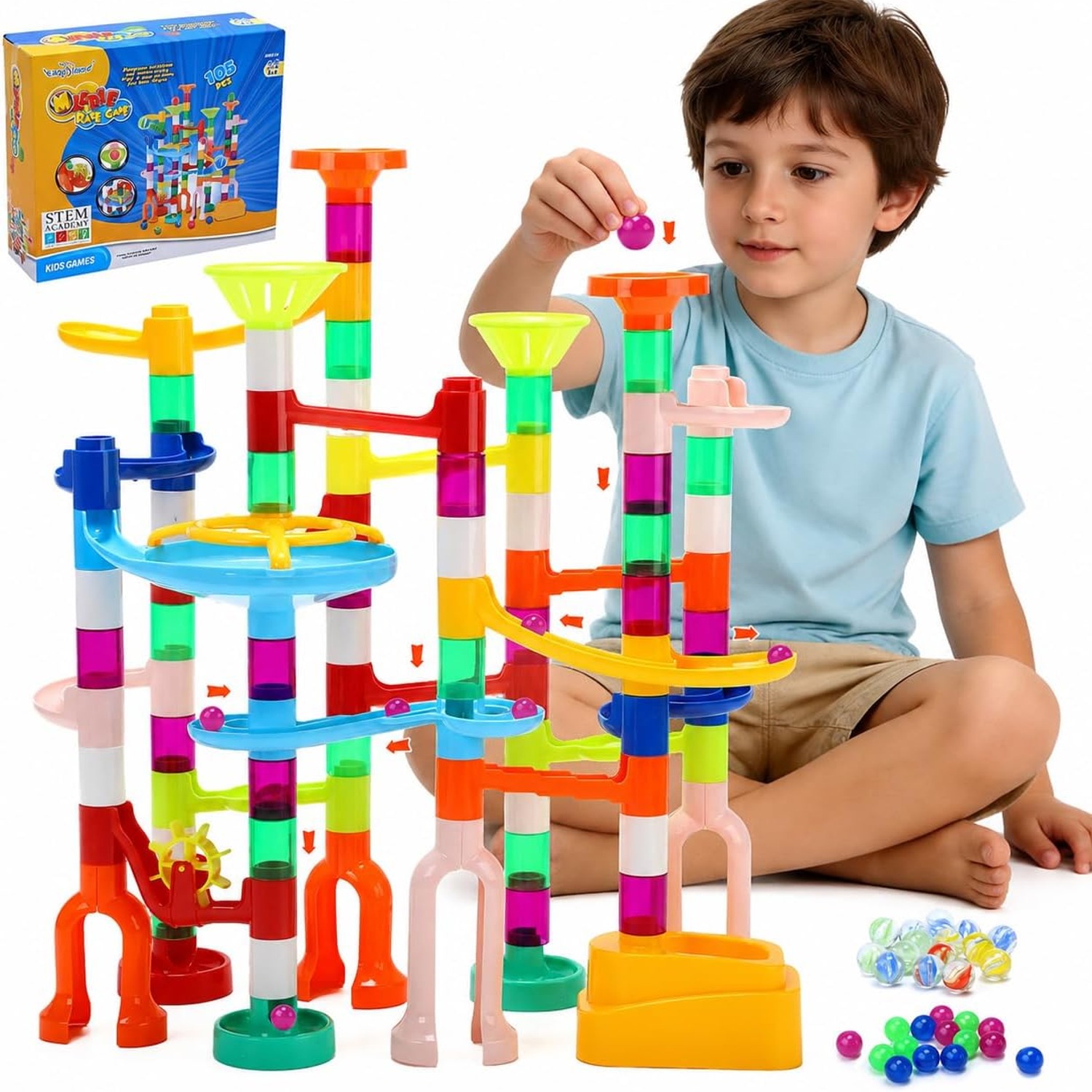
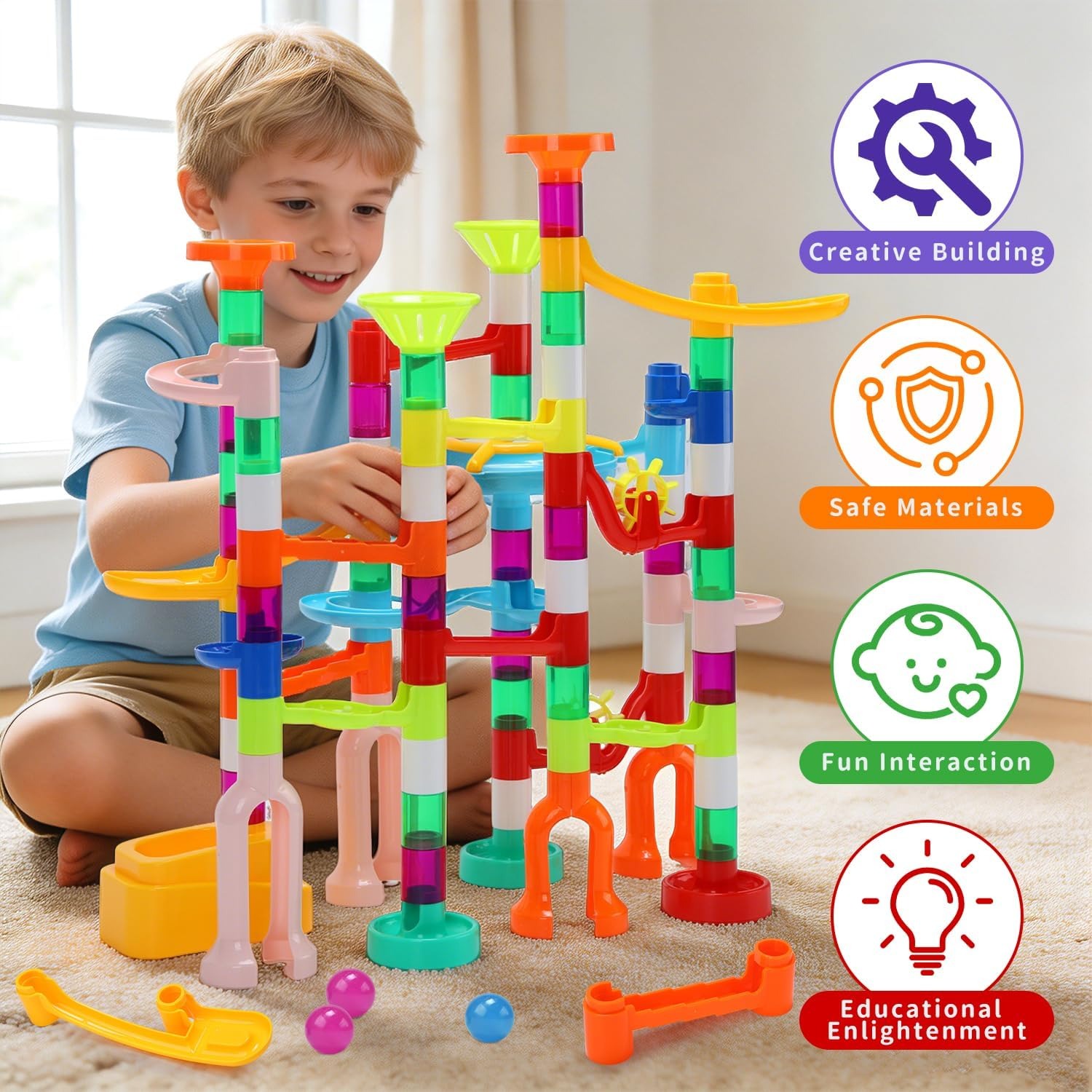
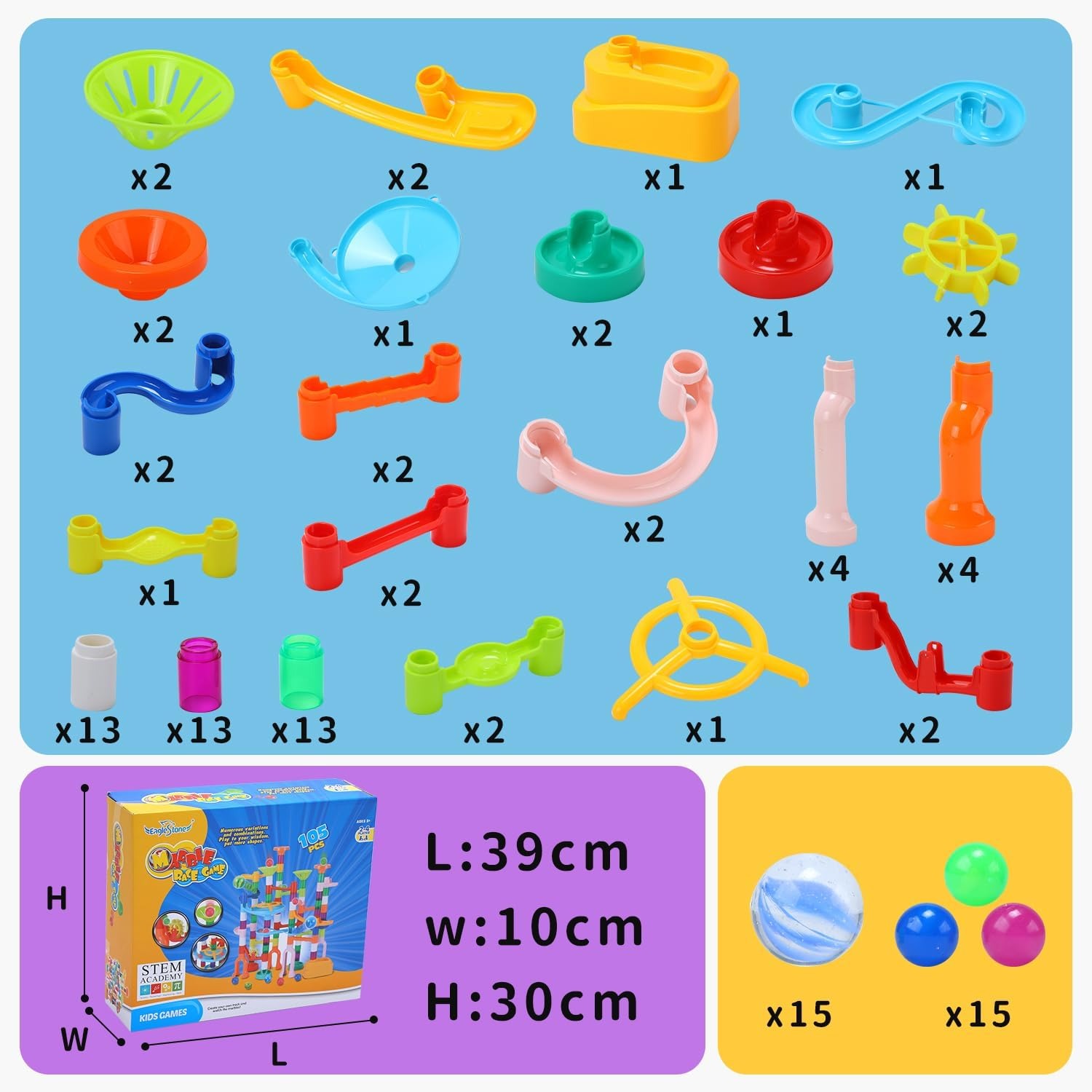
This 105 piece set includes several kinds of parts. Straight sections carry the marble along. Curves change direction. Slides drop it down a level quickly. Funnels catch a marble and spin it round before letting it fall through the middle. Spinning track parts add a bit of theater, since you can see the marble do something before it carries on.
Four entrances sit at the top of the build. That means four marbles can be released at the same time, each taking its own path. At the bottom, four collection zones catch them. If two children launch at once, there is a genuine race with a visible winner, and no one is standing around waiting.
The connecting pieces are what hold the whole thing together. They grip rather than just balance, which matters because a marble hitting a curve at speed puts real force on the join. A structure that stays up is a structure a child keeps playing with.
Who this set suits
The recommended age range is 36 months to 12 years, which is unusually broad for one toy.
At the younger end, around three or four, a child will build short low runs and will need a hand now and then. That is fine. The satisfaction at that age comes from the marble moving at all, not from a complicated design. Supervision matters here because marbles are small and glass ones are hard.
From roughly five to eight, children start building without help and begin planning ahead. They will try to join two separate paths, or work out how to feed one funnel from two directions. This is usually the peak age for a set like this.
Older children, nine and up, treat it more like an engineering challenge. They build tall, they test how fast a marble can go, they work out the minimum slope that still keeps things moving. Some will combine it with books, boxes and furniture to add height.
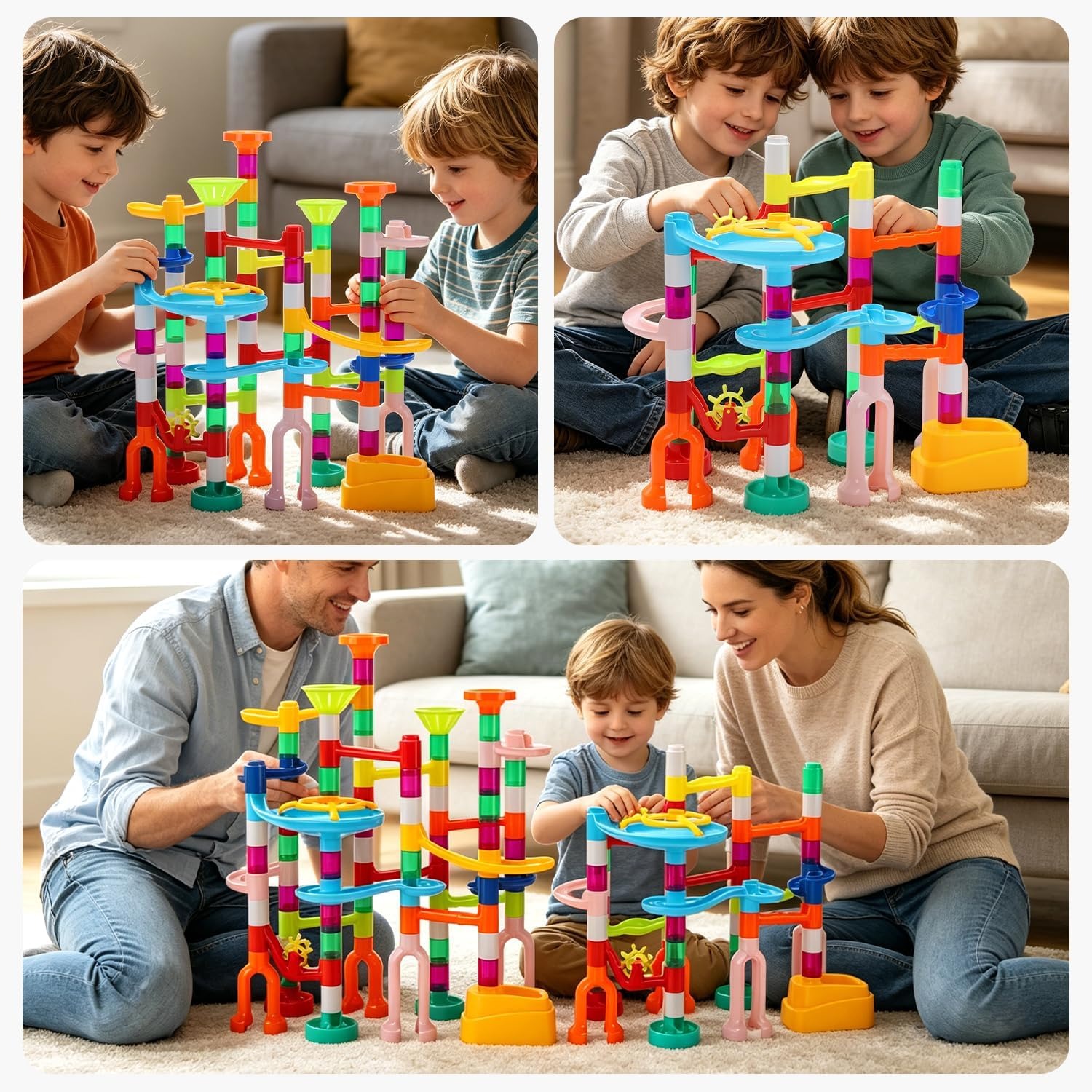
It also works well for mixed age groups. A younger sibling can hand pieces over and launch marbles while an older one does the structural work.
How to choose a marble run
If you are comparing sets, a few things matter more than the headline numbers.
Piece count tells you about scale, not quality. One hundred and five pieces is enough to build something genuinely tall and to run more than one path at once. Smaller sets of thirty or forty pieces tend to produce one short run and little room to experiment.
Look at the variety of parts. A set that is mostly straight tubes gets dull. Curves, funnels, slides and spinners give a child different problems to solve and different effects to watch. Variety is why the same box can produce a new layout every time.
Check how many entrances there are. Single entry sets are solo toys. Multiple entrances turn the same set into a race, which changes how it gets used in a household with more than one child.
Think about stability. Pieces that only stack tend to collapse, and collapse is frustrating rather than educational past the first few times. Interlocking connectors are worth looking for.
Consider the age span. A set that covers preschool through to pre teen earns its shelf space. One that suits a narrow two year window does not.
Material matters for durability. ABS plastic, which this set uses, is the standard for building toys because it is rigid and takes knocks without cracking. It also wipes clean easily, which you will appreciate.
Setting it up for best results
Build on a hard flat floor if you can. Carpet absorbs the base and makes tall structures lean, and it swallows marbles that roll off the end. A dining table works, though a floor gives more room and a shorter fall if things topple.
Put something at the bottom to catch stray marbles. A shallow tray, a baking sheet or even a towel folded into a lip will do. This one small step cuts the number of marbles that disappear under furniture by an enormous amount.
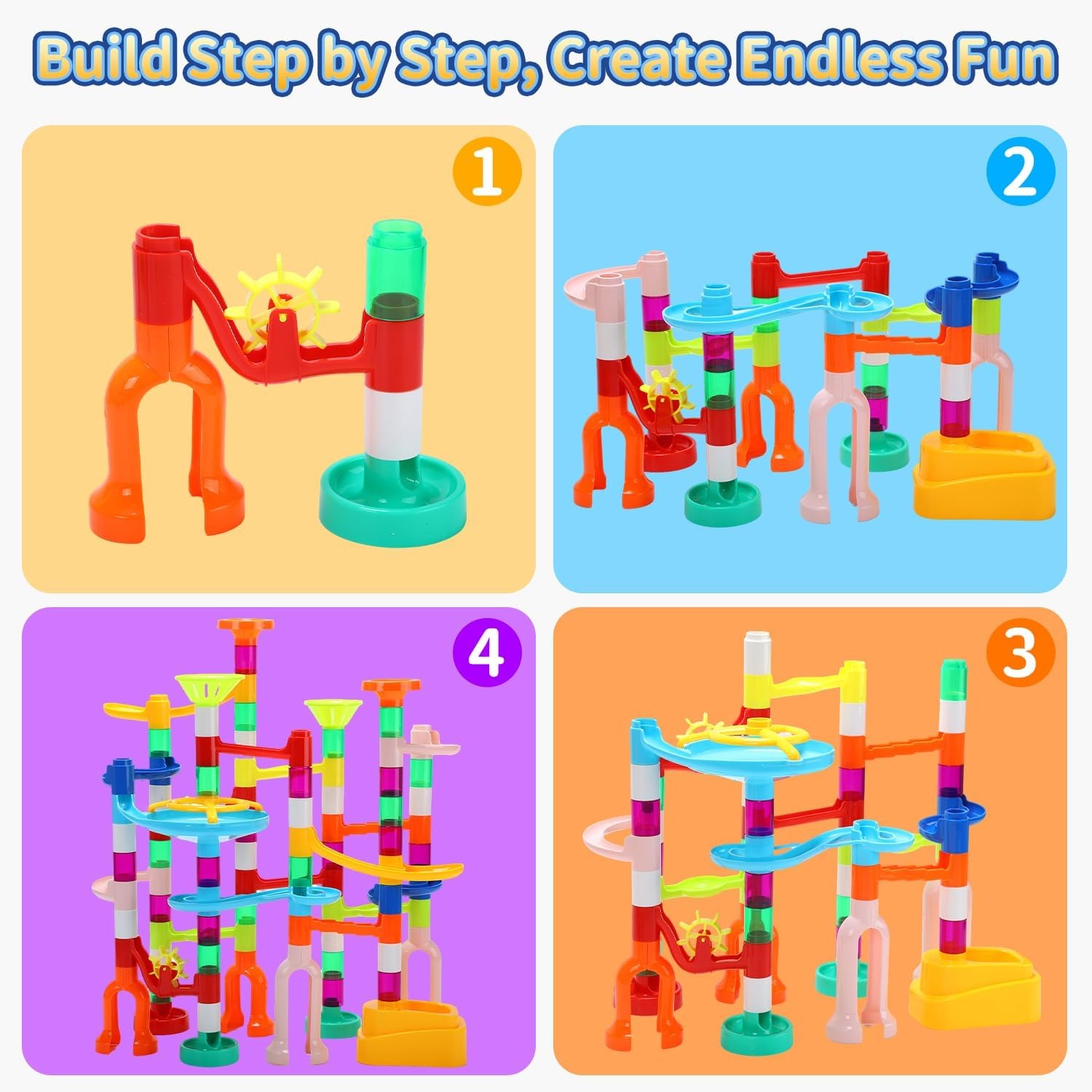
Start low. A child who tries to build five feet tall straight away usually ends up with a pile of parts and a bad mood. Getting one short run working properly, then adding height, teaches a much better habit and produces a better result.
Let them fail a bit. The temptation to step in and fix a stalled marble is strong, but the thinking that happens in those thirty seconds is the whole point of the toy.
Looking after the set
Care is straightforward. Wipe the pieces with a damp cloth and a little mild soap when they get grubby, then dry them fully before they go back in the box. Skip the dishwasher and avoid hot water or radiators, since heat can warp plastic.
Glass marbles deserve a quick check every so often. If one has a chip or a sharp edge, take it out of circulation. They are cheap to replace and not worth a cut finger.
Storage is the thing most families get wrong. Loose parts in a toy box means half the set vanishes within a month. A lidded tub, a zip bag or a shoebox with a marble pouch inside keeps everything together, and counting marbles back in becomes part of the pack away routine.
Gifting notes
This works as a gift for a wide range of occasions. Birthdays, Christmas, Easter, end of school year, or a reward that is not another screen. The broad age range means you do not have to know the child's exact developmental stage to get it right.
It also suits households trying to cut screen time without making a big announcement about it. A marble run competes with a tablet on its own terms, because the child is in control and something new happens each time.
If you are buying for a classroom or a childcare setting, the multiple entrances help, since several children can use one set at the same time rather than waiting in line.
The short version
A 105 piece marble run kit gives children a lot of building toy for one box. Curves, funnels, slides and spinners mean the layouts never have to repeat. Four entrances and four collection zones turn it into a race rather than a solo activity. ABS plastic holds up to daily handling, and the recommended range of 36 months to 12 years means it stays relevant for years rather than months.
Build it on a flat floor, keep a tray under the finish line, store the marbles in their own container, and let the child work out the tricky bits themselves. That is most of what you need to know.