
The complete guide
Buying a Gesture Control Stunt Car: What Actually Matters
The problem with most remote control cars
A lot of RC cars get played with hard for about two weekends and then live under a bed. The reasons are usually the same. The controls take too long to learn, the battery dies after ten minutes and there is no spare, or the car stops being interesting the moment it is the right way up on a flat floor.
A gesture control stunt car attacks all three of those at once. Steering by wrist removes the learning curve, two rechargeable packs double the playtime, and a car that drifts, spins and runs upside down never really "finishes" a session. That is the pitch, and it mostly holds up, but it is still worth knowing what to look for before you buy.
How gesture control works
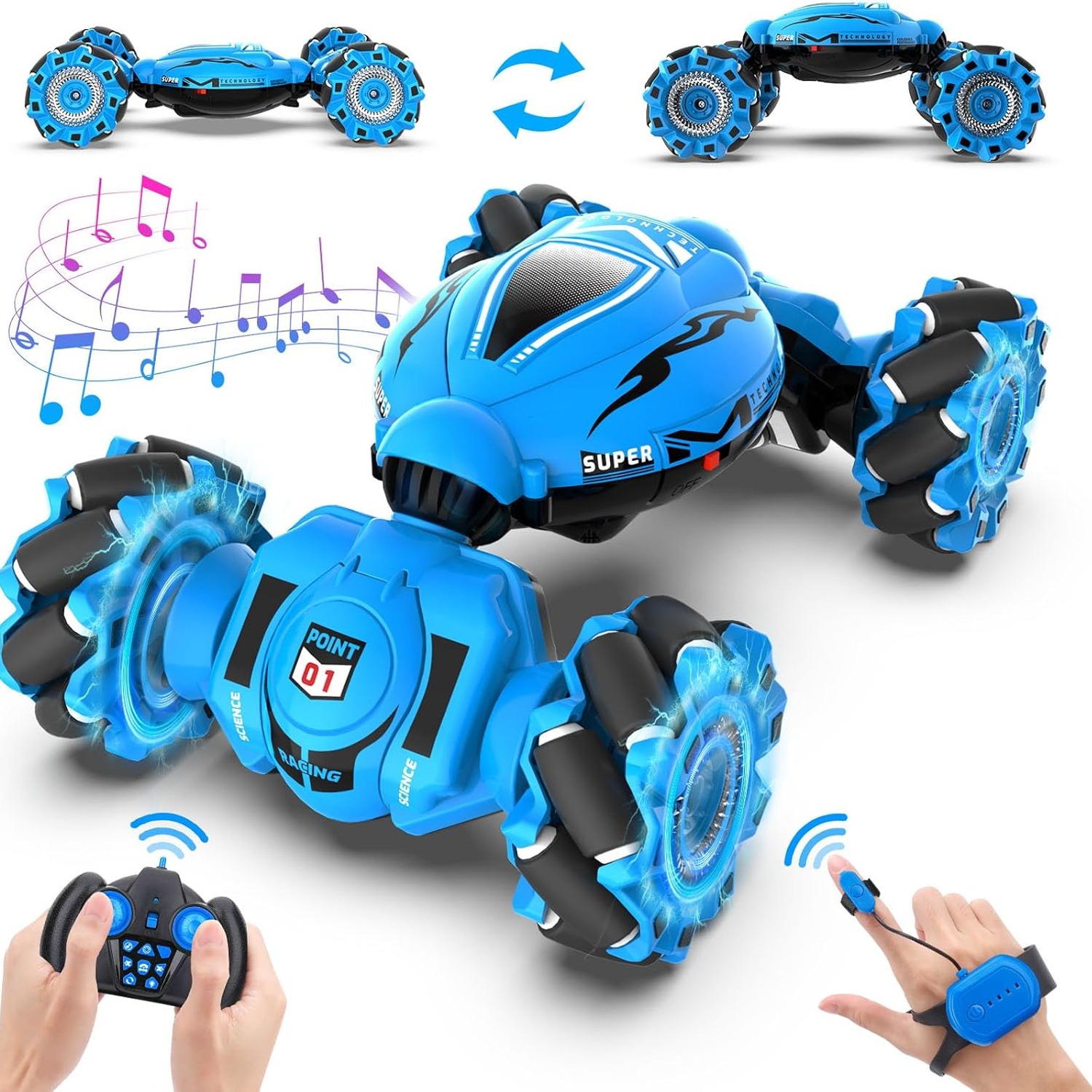
Inside the sensing watch is a motion sensor that reads the angle of your hand. Tilt forward and the car accelerates forward. Tilt back and it reverses. Lean your hand left or right and it turns that way. The watch sends those readings over a 2.4GHz radio link to a receiver in the car, several times a second, so the car tracks your hand almost in real time.
The 2.4GHz part matters more than it sounds. Older toy radios used a small number of fixed frequencies, which meant two cars in the same park would fight each other for control. A 2.4GHz system pairs each car to its own transmitter on its own channel. That is why multiple cars can run in the same room or driveway without one child accidentally driving another child's car into a wall.
There is a short settling-in period with any gesture system. The first minute usually involves over-steering, because a wrist moves further than a thumb does. After that most kids calm their movements down and start driving smoothly. If a child finds the watch frustrating on day one, the included remote gives them a familiar fallback, and plenty of players end up switching between the two depending on what they are doing.
What 4WD and 1:18 scale really give you
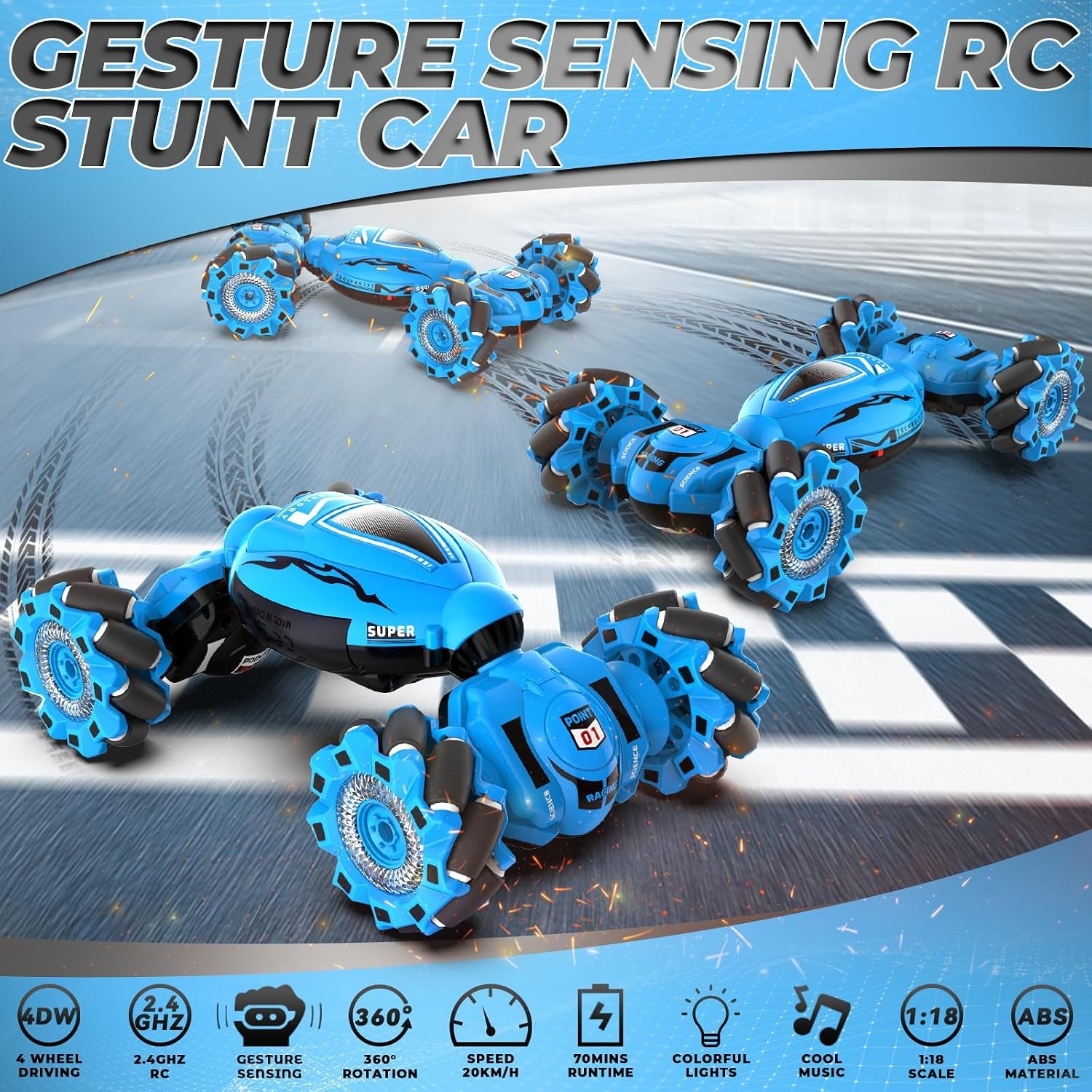
Scale is just a size ratio. At 1:18 this car measures around 12.79 inches long, which puts it in the middle of the range. Small enough to carry out to the yard in one hand, big enough that the wheels can climb over a garden hose or a gravel edge instead of stopping dead at it.
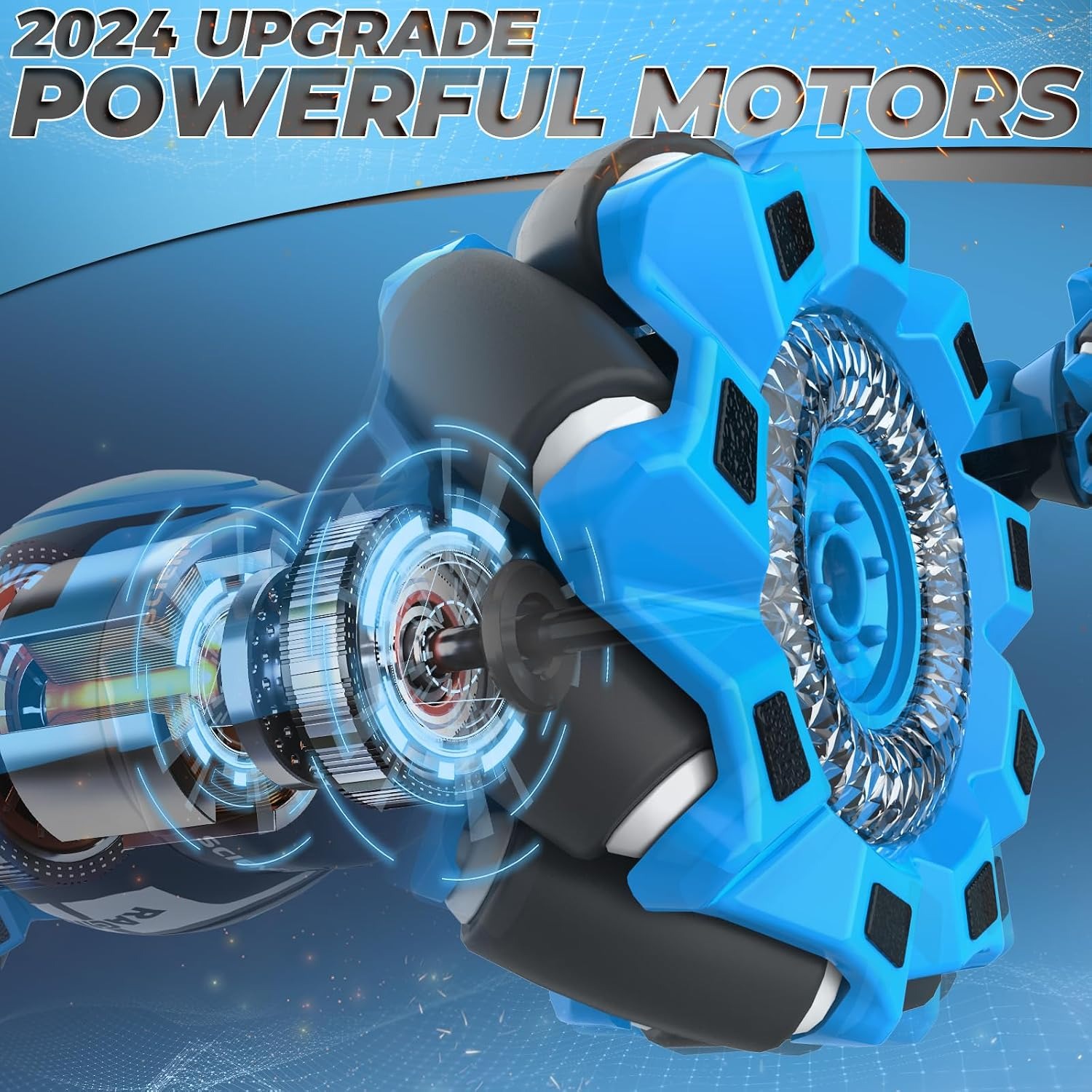
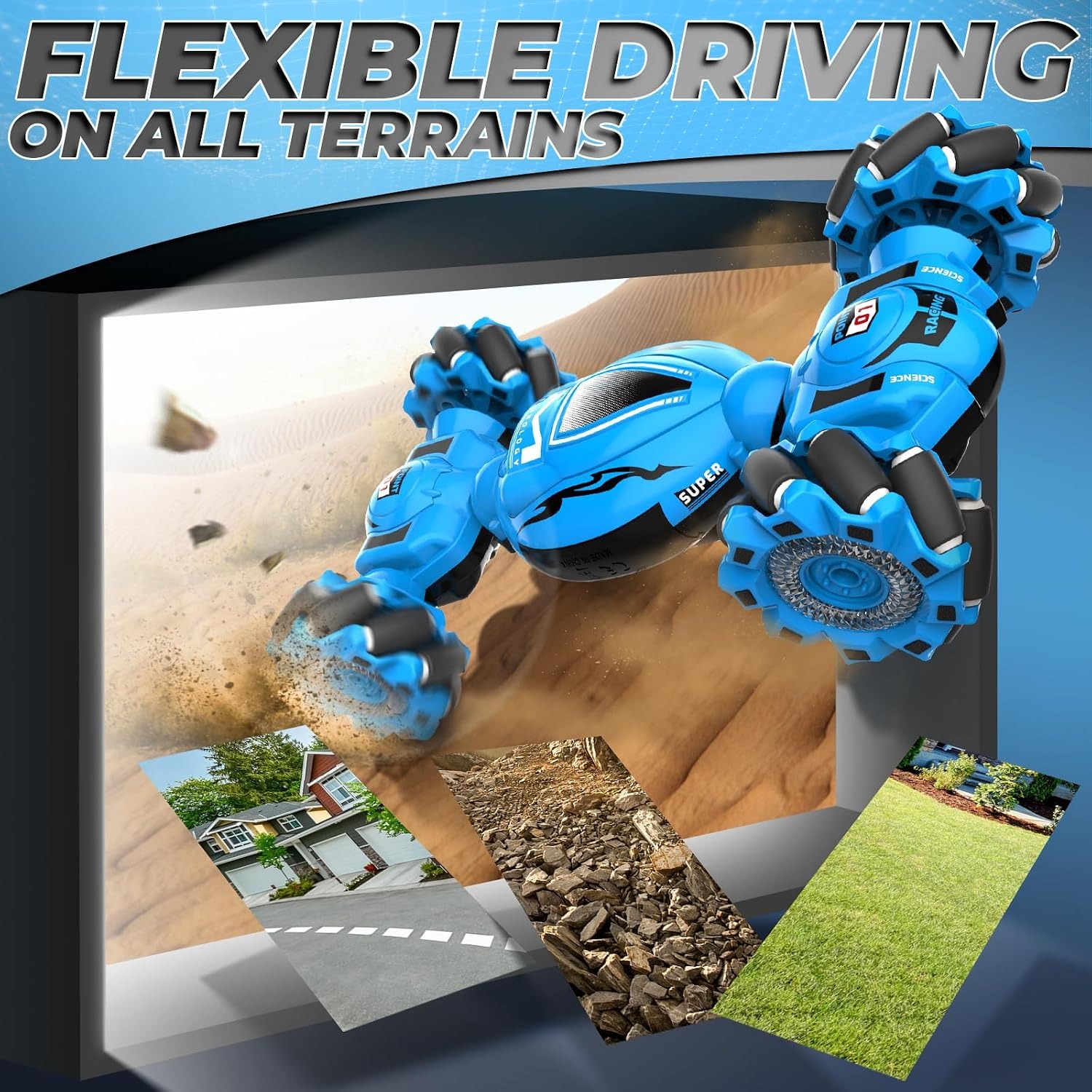
Four wheel drive is the part that changes how a car behaves off smooth ground. With two driven wheels, the moment one loses traction on grass or loose stones, the car spins that wheel and goes nowhere. With all four driven, there is almost always a wheel with grip. That is the difference between an off road remote control car and a toy that only works on the kitchen floor.
The listed top speed is 20 km/h. On paper that number means little; at ground level with a car this size it looks genuinely quick and it crosses a suburban backyard in a few seconds. Expect to lose sight of it occasionally in long grass, which is one reason the lights are more useful than they first appear.
Stunts, flips and why the car drives upside down
The stunt features are what separate this from a plain RC car. It drifts sideways, it rotates a full 360 degrees on the spot, and it flips from one side onto the other and keeps going. Because the body is designed to drive either way up, a tumble off a step is not a reason to walk over and pick it up. The run just continues.
That design decision has a practical benefit beyond the showing off. Most RC cars die of interruption. A child drives, crashes, walks over, resets, drives, crashes. A double sided flip rc car cuts most of those walks out, and continuous play is far more engaging than stop-start play.
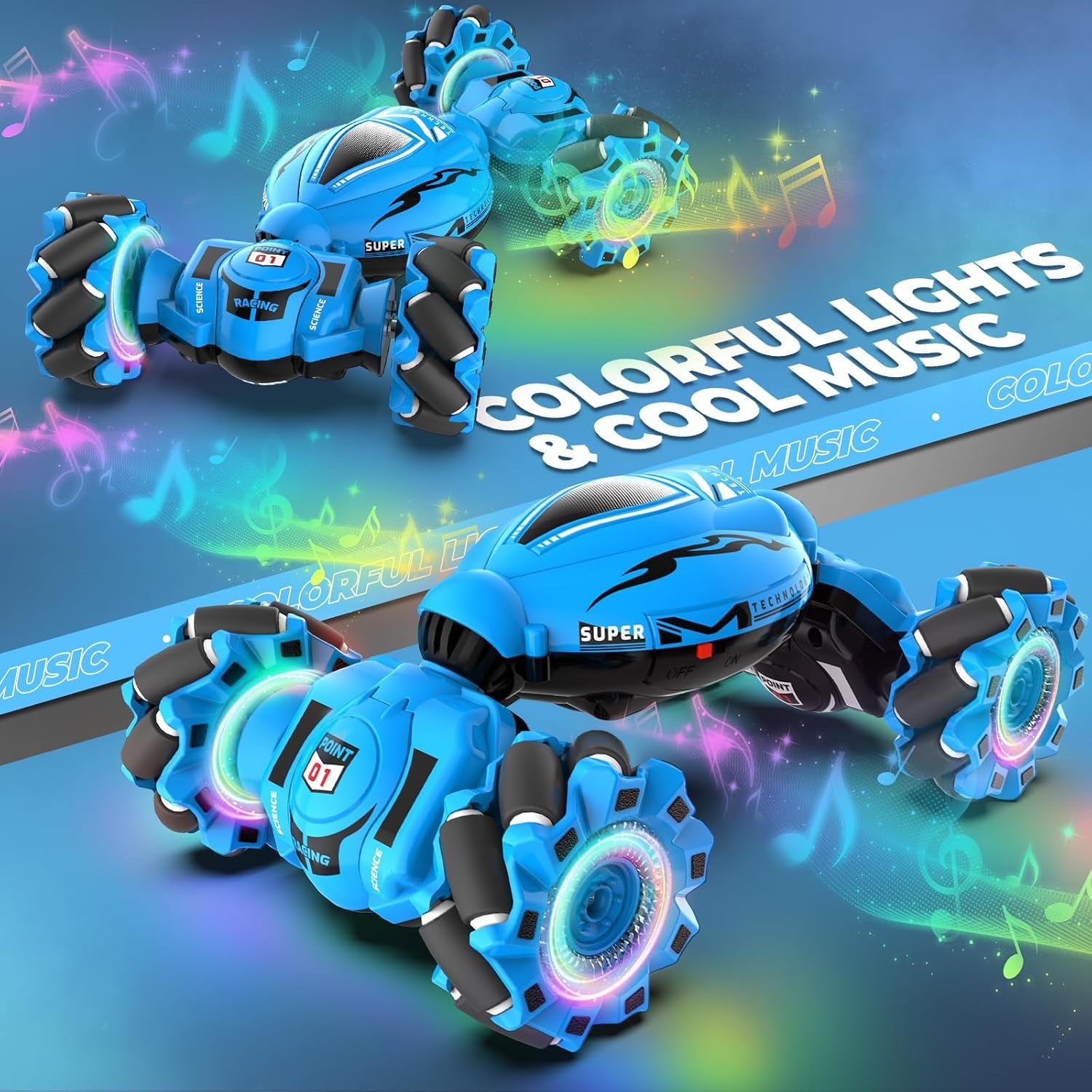
Lights and sound effects run alongside. Some parents groan at that; most kids consider it half the point. The lights genuinely help in a dim hallway or under trees, where a dark blue car disappears fast.
Batteries, runtime and the two-pack habit
This is where a lot of cheaper cars let families down. One battery, no spare, and a charge time that is three or four times the runtime. The math does not work for a child's attention span.
Two rechargeable lithium-ion packs come in this box along with a charging cable. The simple habit to build is this: when one pack goes in the car, the other goes on charge. Done consistently, you rarely hit a dead stop. Exact runtime per pack depends on surface, speed and how much stunting is involved, and it is not given by the maker, but two packs always beat one.
A few charging rules are worth passing on to older kids who will handle it themselves. Use the supplied cable, not a random fast charger. Unplug when the pack is full rather than leaving it overnight. Let a hot pack cool for a few minutes after a hard run before charging it. None of this is complicated, and it adds months to battery life.
Who it suits
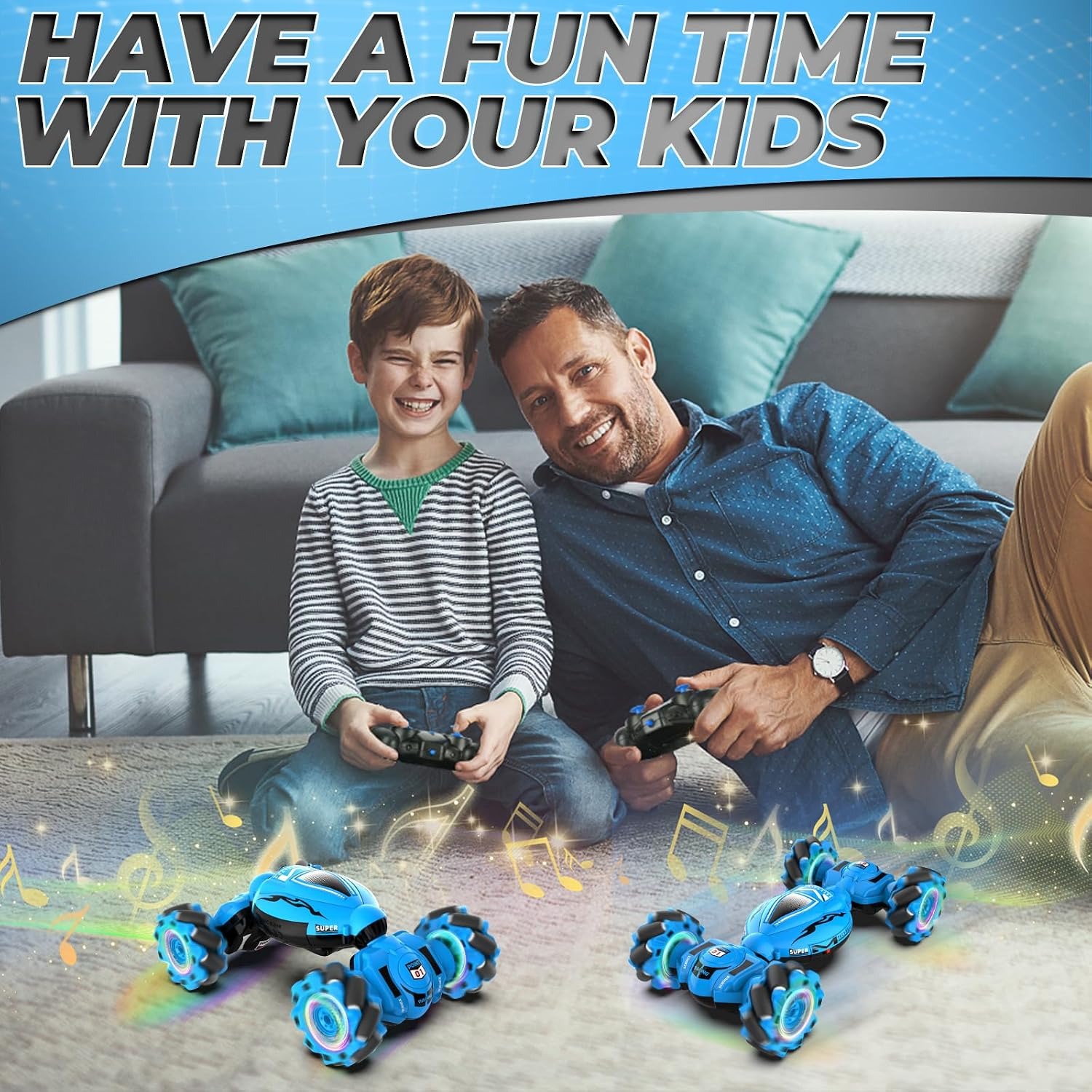
The recommended age is 6 to 12, and that band is sensible. At the younger end, the appeal is the magic of waving a hand and watching a car respond, plus the lights and noise. At the older end, kids start practicing, chaining drifts and setting up ramps and obstacle courses out of whatever is lying around.
It is a single-player toy in the sense that one watch drives one car. Buy a second and you have racing, which is where it gets loud and competitive in the best way. It also works well as a shared family toy, because the hand control means an adult who has never touched an RC car can take a turn without an awkward tutorial.
If the child in question is under six, this is probably a bit quick and a bit fiddly. If they are older than twelve and already into hobby-grade RC, they will likely want something with proportional steering and user-serviceable parts instead.
How to choose between models
If you are comparing a few options, a short checklist helps more than reading every spec sheet.
Count the batteries. One pack is a red flag unless spares are cheap and easy to buy. Check the drivetrain, since 4WD is worth paying for if the car will ever leave a hard floor. Look at the control frequency; 2.4GHz is what allows multiple cars without interference. Then look at the material, because ABS is what you want for a toy that will be thrown into walls, and most decent cars use it.
Finally, think about where it will be driven. If it is an apartment with hard floors and limited space, speed matters less than control. If it is a yard with grass, gravel and a few steps, the all terrain side becomes the deciding feature.
Looking after it
Care is mostly common sense. Wipe the body and wheels after outdoor runs and let the car dry before you charge anything. Clear grit out of the wheels and joints so nothing jams. Keep water away from the watch, the battery compartment and the charging port, because this is not a waterproof toy and damp electronics fail quietly rather than loudly.
Store the car and batteries somewhere cool and dry. If it is going to sit unused for a month or two, take the packs out. Check the wheels occasionally for hair and thread wound around the axles, which is the single most common cause of a car that suddenly feels sluggish.
The short version
This is a 1:18 scale, 4WD stunt car with a 2.4GHz gesture sensing watch, two rechargeable lithium-ion batteries, lights, sound and a listed top speed of 20 km/h, built in ABS and aimed at ages 6 to 12. The gesture watch gets a child driving within a minute. The 4WD gets it across grass and gravel. The second battery is the quiet reason it keeps getting used.
If you want an RC car that survives the first two weeks and still comes out of the closet three months later, the combination of easy controls, real stunt ability and a spare battery is a strong place to start.