Toy Warehouse
Company
Shop By Category
T&Cs
Shop Online
  • Box contents listed
  • Free tracked USA-wide delivery over $100
  • 14-day returns

Solar System Floor Puzzle | Kids floor jigsaw | Space puzzle for kids

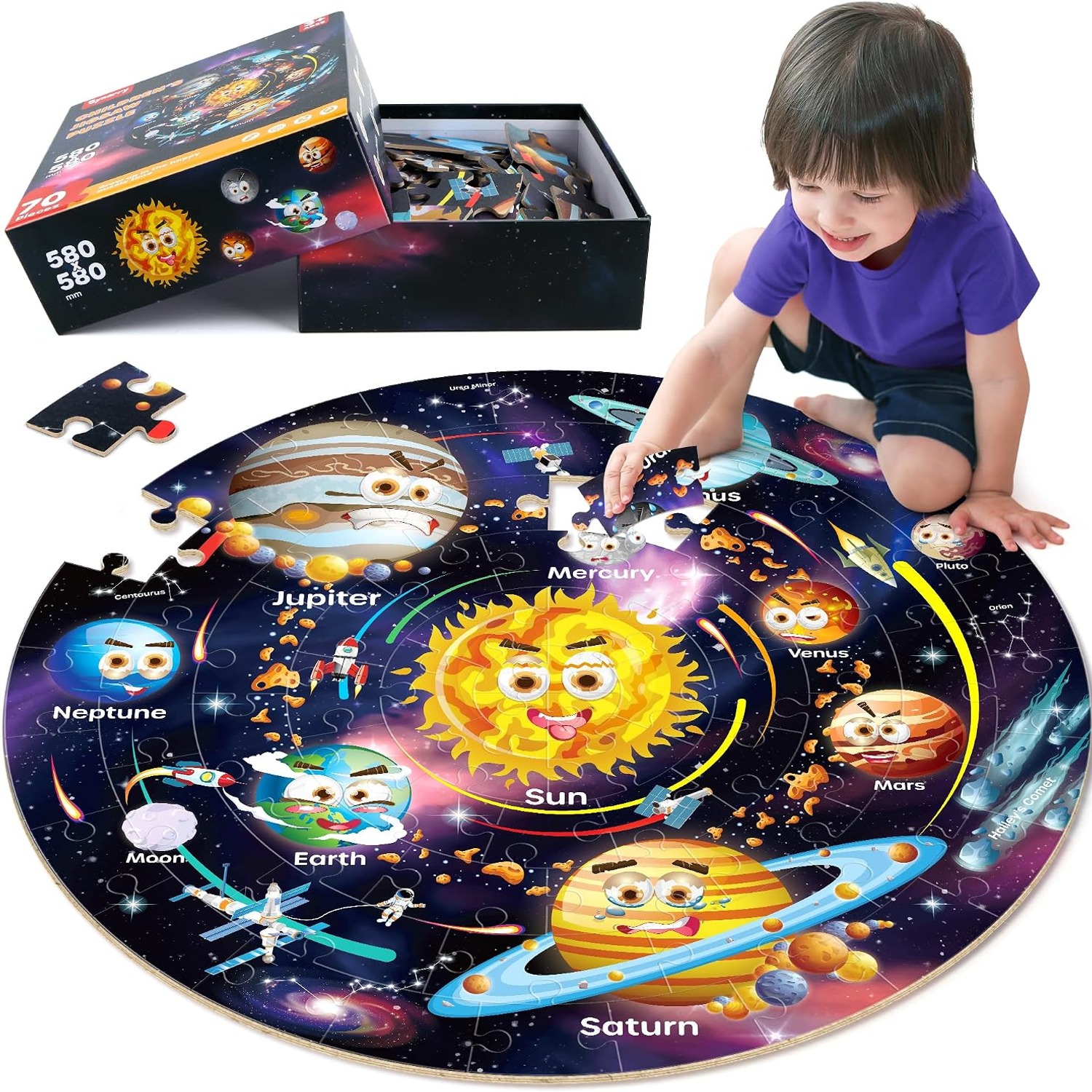
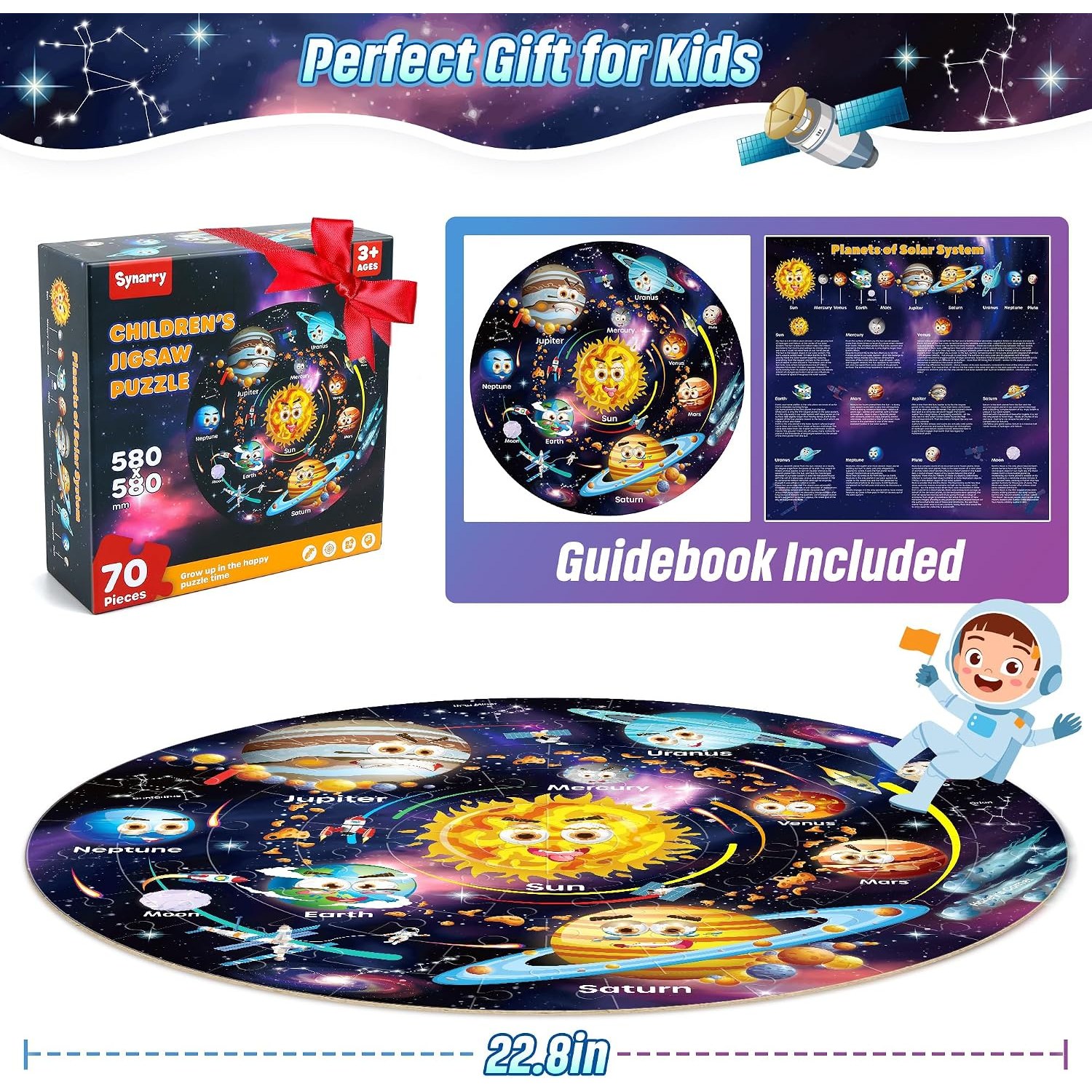
Solar System Floor Puzzle 70 Piece Round Jigsaw

$51.99 $61.99 Save $10
  • Whole Solar System
  • 70 Chunky Pieces
  • Builds Real Skills
  • Ready To Gift

Price: $51.99 $61.99

  • Free tracked USA-wide delivery on orders $100+, otherwise a flat $15
  • Pay by card or PayPal, handled by the payment provider
  • 14 days to change your mind, plus your statutory rights
Product specifications
BrandSYNARRY
Model NumberSYNP056
Manufacturer Part NumberAMZ-056
Puzzle TypeJigsaw
Number of Pieces70
SizeLarge 70 Piece
Item ShapeRound
ThemePlanet
Product StyleSolar System
Material TypeWood
Skill LevelBeginner
Age Range3+
Recommended Age36 months to 8 years
Educational ObjectiveConcentration, hand-eye coordination, logical thinking, matching, observation, patience, problem solving
Number of Players1
Play LocationTabletop
Operation ModeManual
Included ComponentsPuzzle
Number of Items1
Unit Count70 Count
Item Dimensions (L x W)8.26 in x 8.26 in
Item Dimensions (L x W x H)8.26 x 8.26 x 0.04 in
Item Weight1.8 lb
Shipping Weight0.82 kg
WarrantyLifetime warranty against manufacturer's defects
Weight0.82 kg
Shipping & returns

Tracked delivery anywhere in the USA. It is free on orders of $100 or more, and a flat $15 below that.

If it is not right for you, send it back within 14 days of delivery in resaleable condition and we refund the price you paid, including standard delivery. That is a voluntary policy we offer on top of your legal rights. You cover the cost of returning it unless the item is faulty.

If it arrives faulty, damaged or not as described, we put it right at no cost to you under the consumer protection law of your state and the Federal Trade Commission Act, return postage included.

Shipping details · Refunds and returns

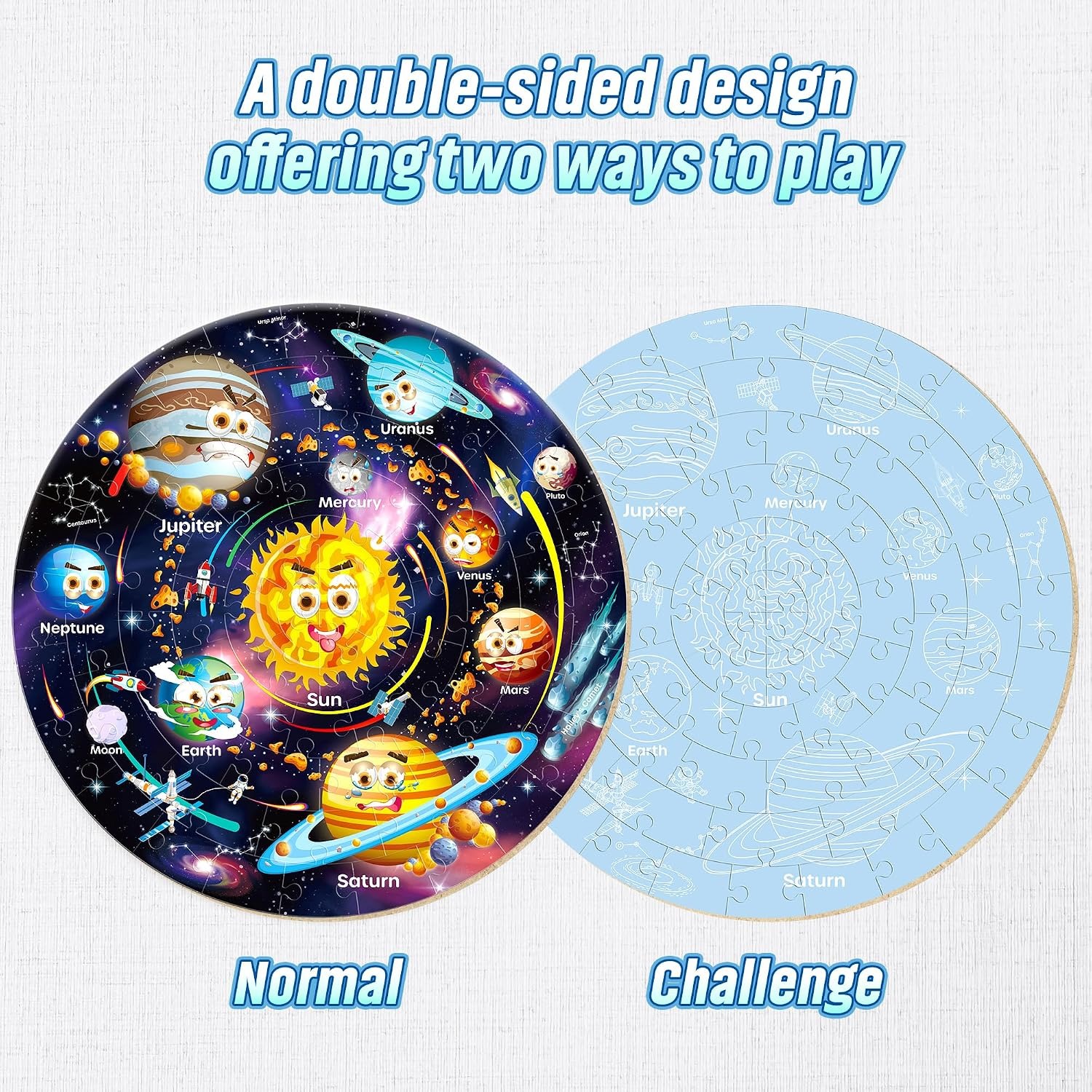
Whole Solar SystemThe sun and the planets in one big round scene kids can name as they build.
70 Chunky PiecesA beginner piece count that feels like a real challenge without causing meltdowns.
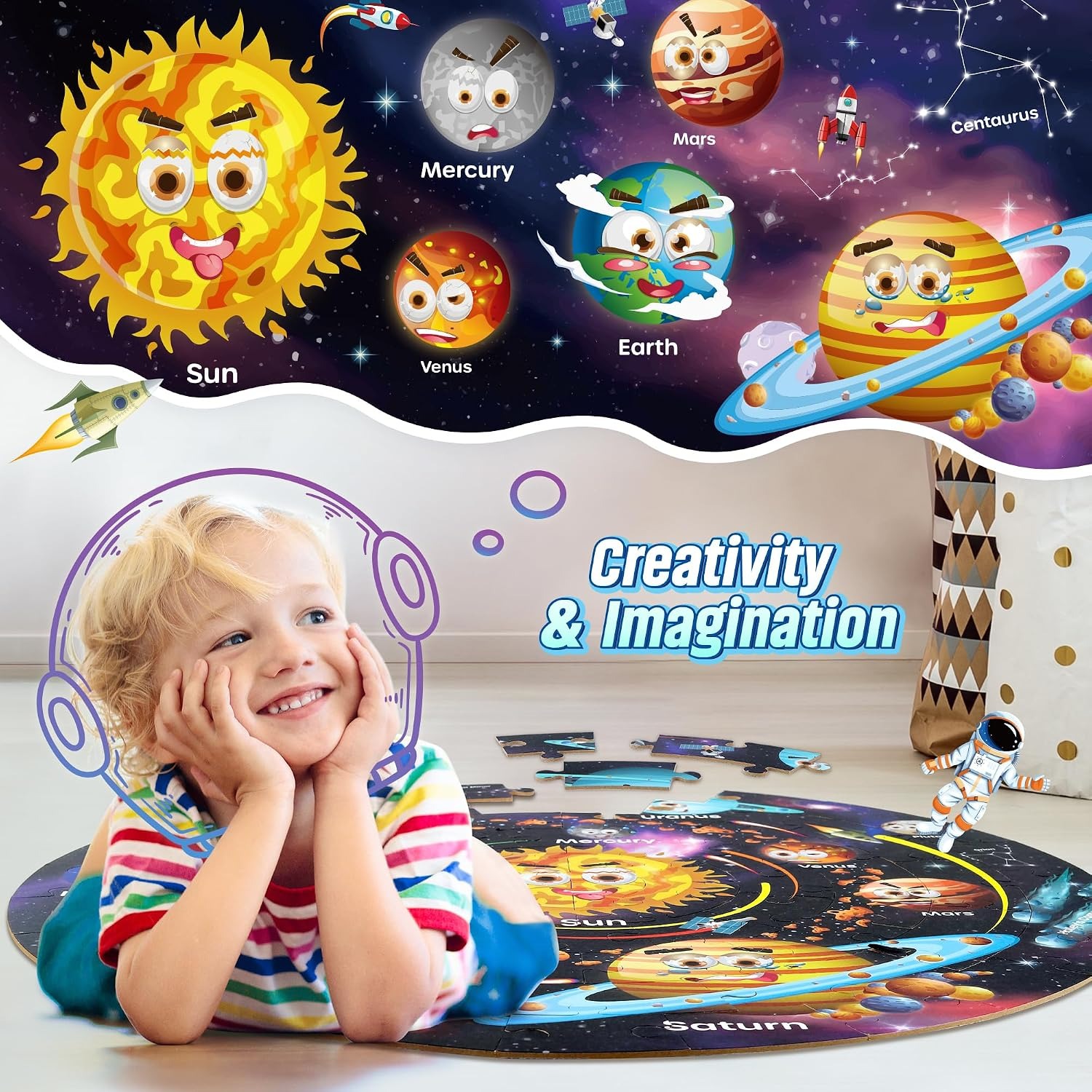
Builds Real SkillsWorks on concentration, matching, patience and hand-eye coordination at once.
Ready To GiftArrives in its own box, so it goes straight under the tree or into a party bag.

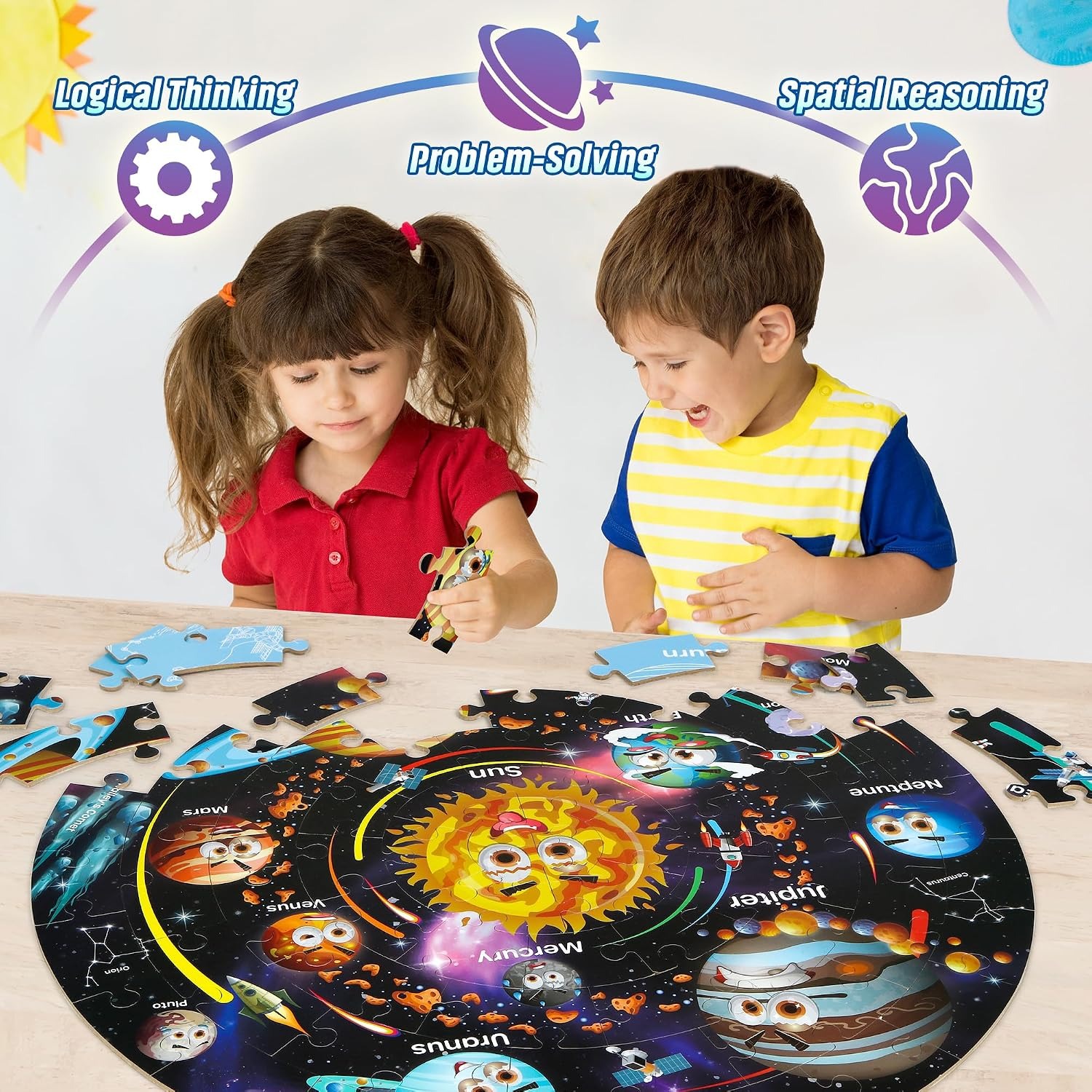
Spread the whole solar system across the rug and watch a curious child lose an hour to a solar system floor puzzle.

A 70-piece round jigsaw with chunky, smooth-edged pieces that builds concentration, hand-eye coordination and problem solving while kids learn the order of the planets.

A 70-piece round floor jigsaw that puts the sun and the planets into one bright scene children can spread out and study.

Designed for ages 3 and up, with a beginner skill level that suits children roughly 4 to 8 who are ready to move past chunky preschooler puzzles.

Every build quietly works on concentration, matching, observation, logical thinking, patience and problem solving.

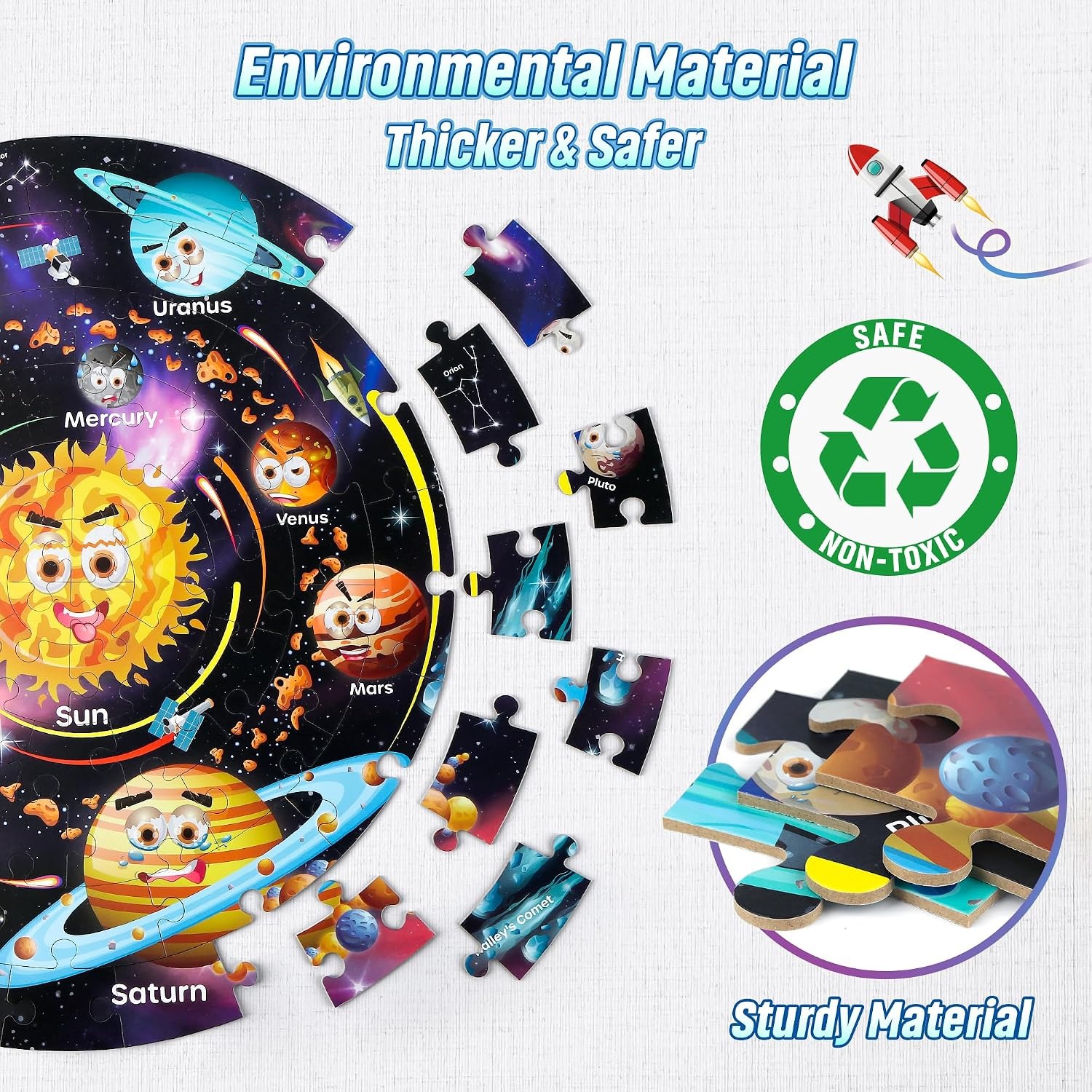
Pieces are cut from wood material and finished at the edges so small hands can grip and place them again and again.

Packs back into its own box between sessions, which makes it easy to store, carry to a grandparent's house or wrap as a birthday present.

Solar System Floor Puzzle 70 Piece Round Jigsaw

Most children meet space for the first time through a picture book or a cartoon, and the names go in one ear and out the other. A puzzle works differently. When a child has to find the piece that holds half of Saturn, and then hunt for the other half, those shapes and names stick. This solar system floor puzzle turns the planets into something a child physically handles, sorts and rebuilds, which is why it tends to hold attention longer than a poster on the wall.

Solar System Floor Puzzle 70 Piece Round Jigsaw

The puzzle is round rather than rectangular, with 70 pieces that lay out into one large circular scene. Round puzzles behave a little differently to standard ones, because there is no straight border to build first. Children have to work from the picture, grouping by color and by shape, which is exactly the kind of thinking that makes a jigsaw useful. The skill level is listed as beginner, so it is a stretch rather than a wall for the age group it targets.

Solar System Floor Puzzle 70 Piece Round Jigsaw

SYNARRY lists the recommended age as 36 months to 8 years, which covers a wide span of ability. A three year old will usually need an adult sitting alongside, sorting pieces into little piles and talking through the picture. A five or six year old will often get going alone after one guided run. By seven or eight, most children can finish it without help and then start racing their own time, which is when a 70 piece puzzle earns its keep as a quiet weekend activity.

Solar System Floor Puzzle 70 Piece Round Jigsaw

Material type is listed as wood and the finished puzzle measures 8.26 by 8.26 inches with a thickness of 0.04 inches. The item weight is given as 1.8 pounds. Beyond those figures, the maker does not specify a color, a country of origin or a separate box size, so we have left those fields blank rather than guess. What we can say is that it arrives as a single complete puzzle in its own packaging, with nothing else to buy or assemble.

Solar System Floor Puzzle 70 Piece Round Jigsaw

As a gift, it has an easy job to do. It suits a birthday for a child who is into rockets and planets, it works as a Christmas present that does not need batteries, and it is a sensible pick for grandparents who want something the child will actually use on a rainy afternoon. The manufacturer also lists a lifetime warranty against manufacturing defects, which is reassuring on a product that is going to be pulled apart and rebuilt dozens of times.

Not sure yet? That is fine.

A toy has to suit the child it is for, and you cannot always judge that from a photograph. If it is not right for you, send it back within 14 days of delivery in resaleable condition and we refund the price you paid, including standard delivery. That is a voluntary policy we offer on top of your legal rights.

If it turns up faulty, damaged or not as described, that is on us. The consumer protection law of your state covers you, and we pay the return postage. Read the full detail on our refunds and returns page, or ask us anything before you order.

Frequently Asked Questions

What exactly is included?

One 70 piece solar system jigsaw puzzle, supplied in its own packaging. The maker shows a single item with the puzzle as the only included component, so there is nothing extra to buy before your child can start.

How many pieces does it have?

Seventy pieces. That is described as the large size for this puzzle and it sits comfortably between simple preschooler puzzles and the 100 plus piece sets aimed at older children.

What age is this puzzle for?

The age range is listed as 3 and up, with a manufacturer recommended age of 36 months to 8 years. In practice, three and four year olds usually want an adult helping, while six to eight year olds can finish it alone.

Is 70 pieces too hard for a four year old?

Not with a bit of support. The skill level is listed as beginner, so the cuts and the picture are designed to be readable by young children. Sort the pieces into color groups first and most four year olds will get there happily.

Why is the puzzle round instead of square?

The item shape is listed as round, which suits the subject since the planets orbit in circles. A round puzzle also removes the straight edge shortcut, so children have to read the picture rather than just build a frame.

How big is the finished puzzle?

The item dimensions are 8.26 inches by 8.26 inches, with a thickness of 0.04 inches. That fits neatly on a small table, a tray or a patch of carpet.

What is it made from?

The material type is listed as wood. Beyond that, the maker does not specify a finish or coating, so we have not made any further claims about the construction.

Is it suitable for young children?

It is sold for ages 3 and up, which reflects the piece size relative to younger preschoolers. Children under three should not use it, and all puzzle play is better with an adult nearby.

How heavy is it?

Item weight is listed as 1.8 pounds. The shipping weight is 0.82 kg, which includes the packaging.

Can two children build it together?

The maker describes it as a single player activity, but in real life two siblings often share one puzzle happily. Give each child their own pile of pieces so they are not grabbing from the same spot.

What skills does it actually teach?

The stated educational objectives are concentration, hand-eye coordination, logical thinking, matching, observation, patience and problem solving. Alongside that, children pick up the names and relative positions of the planets just by handling them.

Is this a good STEM toy?

It works well as an early science and spatial reasoning activity, which is why many parents shortlist it when looking for the best STEM toy for preschoolers. It introduces astronomy in a hands on way rather than through a screen.

Does it show all the planets?

The theme is listed as planet and the product style as solar system, so the scene is built around the sun and planets. The exact artwork detail is shown in the product images.

Is the puzzle scientifically accurate?

It is an illustrated children's puzzle rather than a scientific chart, so it is designed to introduce the planets in a friendly way. Use it as a starting point and pair it with a library book if your child wants more detail.

Can it be used on the floor or only on a table?

The play activity location is listed as tabletop, but at 8.26 inches across it works just as well on a rug or a low coffee table. A hard, flat surface makes the pieces easier to slide into place.

Will the pieces hold up to repeated use?

It is built as a reusable toy rather than a one off activity, and the manufacturer offers a lifetime warranty against manufacturing defects. Teaching children to lift pieces by the edge rather than bending them will add years to its life.

How do I clean it?

Wipe marks with a barely damp cloth and dry straight away. Never soak the pieces or run them under a tap, because moisture is what ruins printed puzzle board.

What if a piece goes missing?

Count the pieces back into the box at the end of every session, which is the single best habit for keeping a set complete. If a piece does vanish, check under rugs and sofa cushions first, since round puzzles tend to shed pieces at the outer edge.

How should I store it?

Put every piece back in its box and keep the box flat and dry, ideally on a shelf rather than in a garage. Stacking heavy items on top will crush the box over time.

Is it portable enough for travel?

Additional features list it as portable, and at 1.8 pounds it is easy to carry. It is better suited to a grandparent's kitchen table than to a car seat, since 70 loose pieces and moving vehicles do not mix.

Does it need batteries or an app?

No. The operation mode is manual, so there is nothing to charge, pair or download. That is a large part of why it works as a screen free activity.

Is this a good birthday gift?

Yes. It arrives as a complete boxed item, it suits a wide age window from three to eight, and it is a safe choice when you know a child likes rockets and planets but not much else about their toy shelf.

Will an eight year old find it too easy?

An eight year old will probably finish it fairly quickly on a second attempt, which many children enjoy, since they start timing themselves. If you want a longer challenge for that age, look at higher piece counts.

How long does one build take?

A first attempt with a young child usually runs 20 to 40 minutes with help. Once a child knows the picture, repeat builds often drop to 10 or 15 minutes.

Can it be glued and framed?

Many families do frame a favorite puzzle, and the round shape looks good on a wall. Use a puzzle glue made for the job and let it dry fully flat before moving it.

Is it suitable for a classroom or daycare?

It suits a quiet corner activity for one child or a pair, and the skill focus on patience and matching fits early years learning goals. For a busy room, consider more than one copy so children are not waiting.

What is the brand and model?

The brand is SYNARRY. The model number is SYNP056 and the manufacturer part number is listed as AMZ-056.

Is there a warranty?

The manufacturer lists a lifetime warranty against manufacturing defects. That covers faults in the product itself rather than normal wear, lost pieces or water damage.

How is it packaged for delivery?

Keep the box, since it doubles as the storage for the pieces.

What if it is not right for my child?

If the puzzle is the wrong fit, arrives damaged or is simply too easy or too hard for the child you bought it for, contact us with your order number and we will sort out a return or exchange. Keep the box and the pieces together, since a complete set makes the process much faster.

How to Choose a Solar System Floor Puzzle That Actually Gets Built

6 min read Toy Warehouse

The problem with most "educational" space toys

Buy a child a space toy and you often end up with one of two things. Either it is a plastic model that looks great for a week and then lives at the bottom of a toy box, or it is an app that teaches the planets but swallows another half hour of screen time. Neither does much for the skills a four or five year old is actually working on, which are patience, focus and the ability to look at a shape and work out where it goes.

A puzzle solves that in a quietly old-fashioned way. There is nothing to charge, nothing to update, and no way to rush it. The child either finds the right piece or they do not, and finding it is the whole reward. That is why a solar system floor puzzle keeps turning up on parents' shortlists when they want something educational that does not feel like homework.

What this one is

This is a 70 piece round jigsaw with a solar system theme. The finished puzzle measures 8.26 inches across, the material type is listed as wood, and the whole thing weighs 1.8 pounds. It is made by SYNARRY under model number SYNP056, and it comes as a single complete item with nothing else to assemble or buy.

The age guidance is 3 and up, with the manufacturer recommending 36 months to 8 years. The skill level is listed as beginner, which is a useful signal. Seventy pieces sounds like a lot if your child has only done 12 piece chunky puzzles, but beginner cuts are generous. The pieces are distinct enough that a child can tell them apart by shape as well as by color.

Why the round shape matters more than it looks

Almost every jigsaw a child meets is a rectangle, and almost every child learns the same trick: find the straight edges, build the frame, then fill the middle. It is a good strategy and it works.

A round puzzle takes that shortcut away. There is no corner piece, and the outer edge is a curve rather than a line. The child has to start from the picture itself, grouping pieces by what they show. That is a genuinely different thinking job, and it is the one that transfers to other problems. If your child already breezes through rectangular puzzles at this piece count, a round one will slow them down in a good way.

The shape also fits the subject. Planets move in circles, and laying the pieces out as a disc makes that obvious without anyone having to explain it.

Matching the puzzle to the child

The three to eight year old span in the age guidance is wide, and the experience is very different at each end of it.

At three and four, treat it as a shared activity. Tip the pieces out, sort them into four or five piles by color, and let the child pick a pile. Talk about what each piece shows. The goal at this age is not a finished puzzle in one sitting, it is twenty focused minutes and a bit of planet vocabulary. Many parents hunting for the best floor puzzle for preschoolers will find this one sits just above true preschooler level, so expect to sit in.

At five and six, most children can get going with a little help at the start. Point out the sun, suggest they build outwards from it, then step back. This is the age where you see the real payoff, because the child starts developing a strategy of their own rather than trying pieces at random.

At seven and eight, it becomes an independent activity. Children at this stage often rebuild the same puzzle several times and try to beat their own time, which is why a reusable set beats a craft kit that gets used once. If your eight year old is a confident puzzler, this will be a short build, so treat it as a confidence win rather than a long challenge.

What it is really teaching

The listed educational objectives are concentration, hand-eye coordination, logical thinking, matching, observation, patience and problem solving. That is a long list, but each one shows up in a way you can actually watch.

Concentration is the obvious one. A child who can stay with a task for twenty minutes without being prompted is building something that matters far beyond puzzles. Hand-eye coordination comes from the small, precise movements of picking up a piece and rotating it into a gap. Matching and observation come from scanning a pile for a particular color or edge. Patience comes from the pieces that do not fit, which is most of them.

Then there is the content. Nobody sits a five year old down and teaches them planetary order, but a child who has rebuilt this scene six times will know where the sun sits and roughly what order the planets go in. That is the quiet advantage of a space puzzle for kids over a flashcard. The learning is a side effect of the fun.

Setting up a session that works

A few small things make the difference between a finished puzzle and an abandoned pile.

Pick a hard, flat surface. Carpet with a deep pile makes pieces tilt and frustrates young children. A kitchen table, a tray or a low coffee table all work better.

Give the puzzle its own space and enough time. Ten minutes before dinner is a recipe for a half-built puzzle swept into a box. A rainy Saturday morning is ideal.

Sort before you build. Tipping 70 pieces into one heap and starting is overwhelming for a young child. Two or three minutes spent grouping by color turns the whole job into something manageable.

Resist the urge to place pieces yourself. If you are helping, narrow the search rather than solving it. Saying "try this little pile" keeps the child in charge.

Looking after it

Puzzles die in predictable ways: water, bending and lost pieces.

Keep food and drinks away from the table while it is out. If something does spill, wipe with a barely damp cloth and dry it immediately rather than letting moisture soak in. Teach children to lift pieces by the edges rather than folding them in half, which is the single most common cause of damage.

For storage, put everything back in the box and keep the box flat and dry. A shelf indoors is fine. A garage, a shed or a damp closet is not, because board absorbs moisture over time. Counting the pieces back in after every session sounds fussy, but it is the only reliable way to keep a set complete for years.

The manufacturer lists a lifetime warranty against manufacturing defects, which covers faults in the product rather than ordinary wear or lost pieces.

Buying it as a gift

This is an easy gift to get right. It arrives boxed and complete, it needs no batteries, and the three to eight age window means you do not have to know a child's exact level to buy with confidence. It suits birthdays, Christmas and the sort of present a grandparent gives when they want something the child will use rather than something that makes noise.

If you are buying for a child who already loves rockets and planets, it lands straight in their interest. If you are buying for a child who has not discovered space yet, it is a gentle introduction. Either way it is a screen free activity that an adult can join in with, which is worth something on a long afternoon.

The short version

Seventy pieces, round, solar system themed, beginner level, ages three to eight. The material type is listed as wood, the puzzle measures 8.26 inches across and weighs 1.8 pounds. It works on concentration, matching, patience and hand-eye coordination while teaching the planets almost by accident.

Buy it for a four to six year old and you get the sweet spot: hard enough to be an achievement, easy enough to finish. Buy it for a three year old and plan to sit alongside. Buy it for an eight year old and expect a quick, satisfying build they will repeat. Keep it dry, count the pieces back in, and it will stay in rotation for years.

Browse the shop

Not sure if 70 pieces is right?

Tell us your child's age and how much puzzling they have done before, and we will point you to the right piece count.

Ask us a question

Page summary

The SYNARRY Solar System Floor Puzzle is a 70 piece round jigsaw with a planet theme, model SYNP056 (manufacturer part number AMZ-056). It is listed for ages 3 and up, with a manufacturer recommended age of 36 months to 8 years and a beginner skill level. Material type is given as wood. The assembled item measures 8.26 by 8.26 by 0.04 inches and item weight is 1.8 pounds, with a shipping weight of 0.82 kg. It is a single player, manual, tabletop activity and is described as portable. Stated educational objectives include concentration, hand-eye coordination, logical thinking, matching, observation, patience and problem solving. The manufacturer lists a lifetime warranty against manufacturing defects. Color and country of origin are not specified by the maker.