
The complete guide
The Buyer's Guide to Wooden Breakfast Play Food Sets
The problem with most toy food
Walk into a lot of playrooms and you will find a plastic tub with forty pieces of pretend food in it. A chicken leg, half a pizza, a lettuce, four grapes, a cupcake, something that might be a fish. None of it belongs together. A child digs through it, pulls out two items, loses interest and wanders off.
The issue is not the amount of food. It is that there is no scene. Children build pretend play around a recognizable situation, and a random pile does not give them one. When the pieces add up to a meal they already know, the game starts on its own.
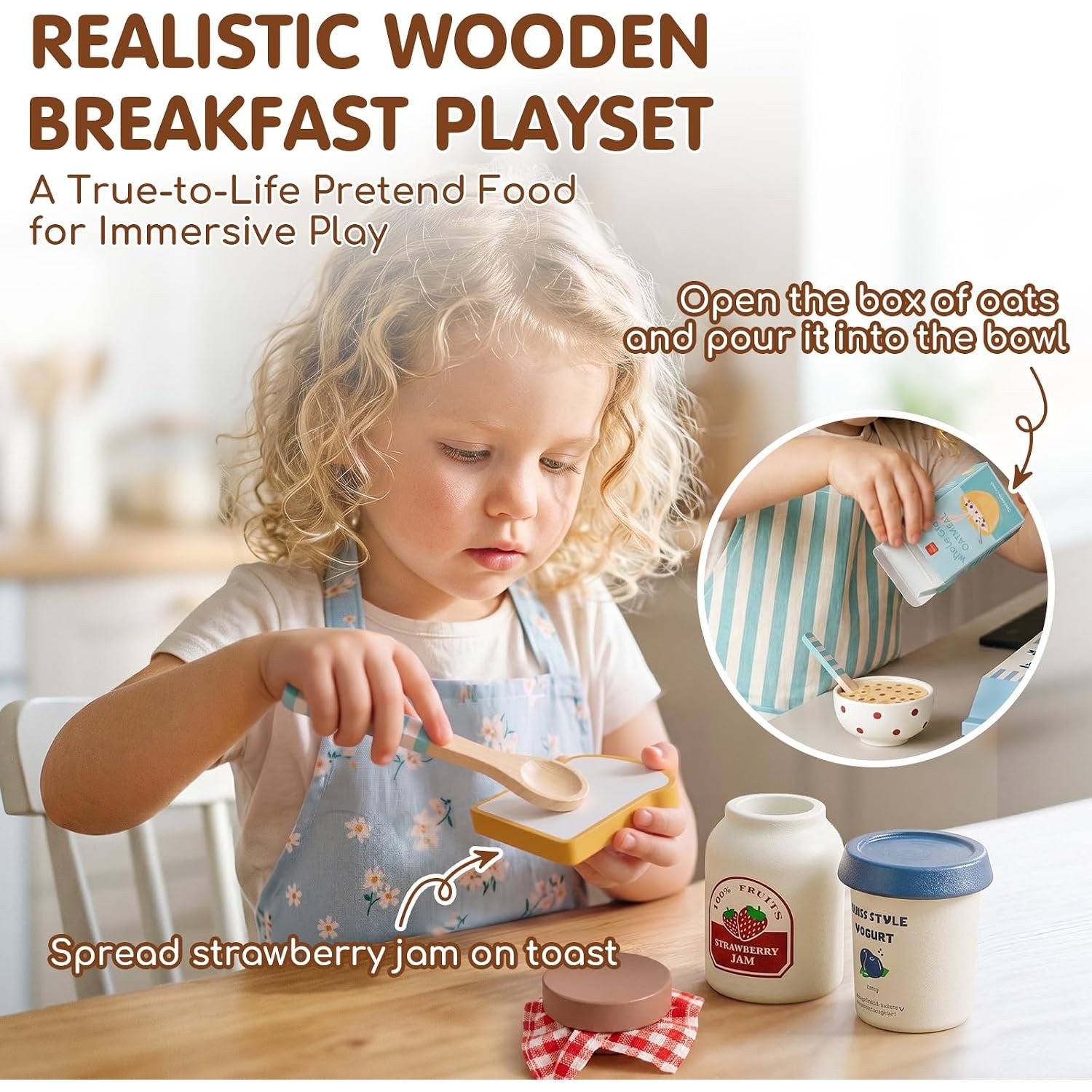
That is what a wooden breakfast play food set does differently. Toast, eggs, fruit, oatmeal, milk and yogurt are not a random assortment. They are the morning your child has lived through hundreds of times. They know the order things happen in. They know who sits where. All they needed was the props.
How a cutting food set actually works
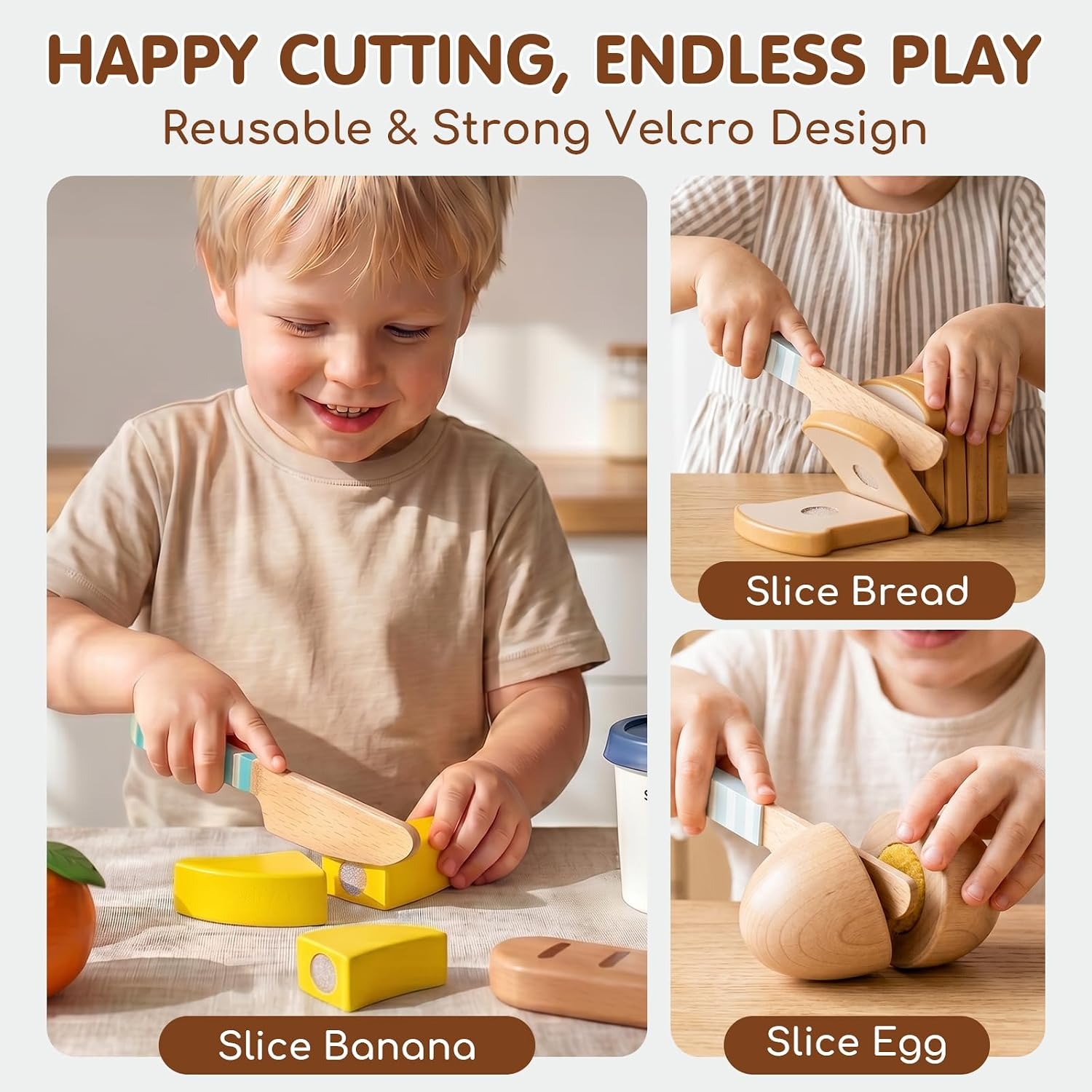
The core mechanic is simple. Certain pieces are made in two halves that hold together until a child runs the toy knife between them. They come apart with a small resistance, then press back together ready for the next round.
Why does that hold attention when a solid lump of toy food does not? Because it gives a clear result. The child does a thing and something visibly changes. Then they can undo it and do it again. Repetition like that is how young children build confidence in a new skill, and they will happily cut the same banana twenty times.
There is real work going on underneath. Holding food steady with one hand while cutting with the other is a two-handed job, and the two hands are doing different things. That bilateral coordination feeds directly into later skills like using scissors, holding a page while writing, and doing up buttons. Add in lining the halves back up and you have hand-eye coordination practice disguised as breakfast.
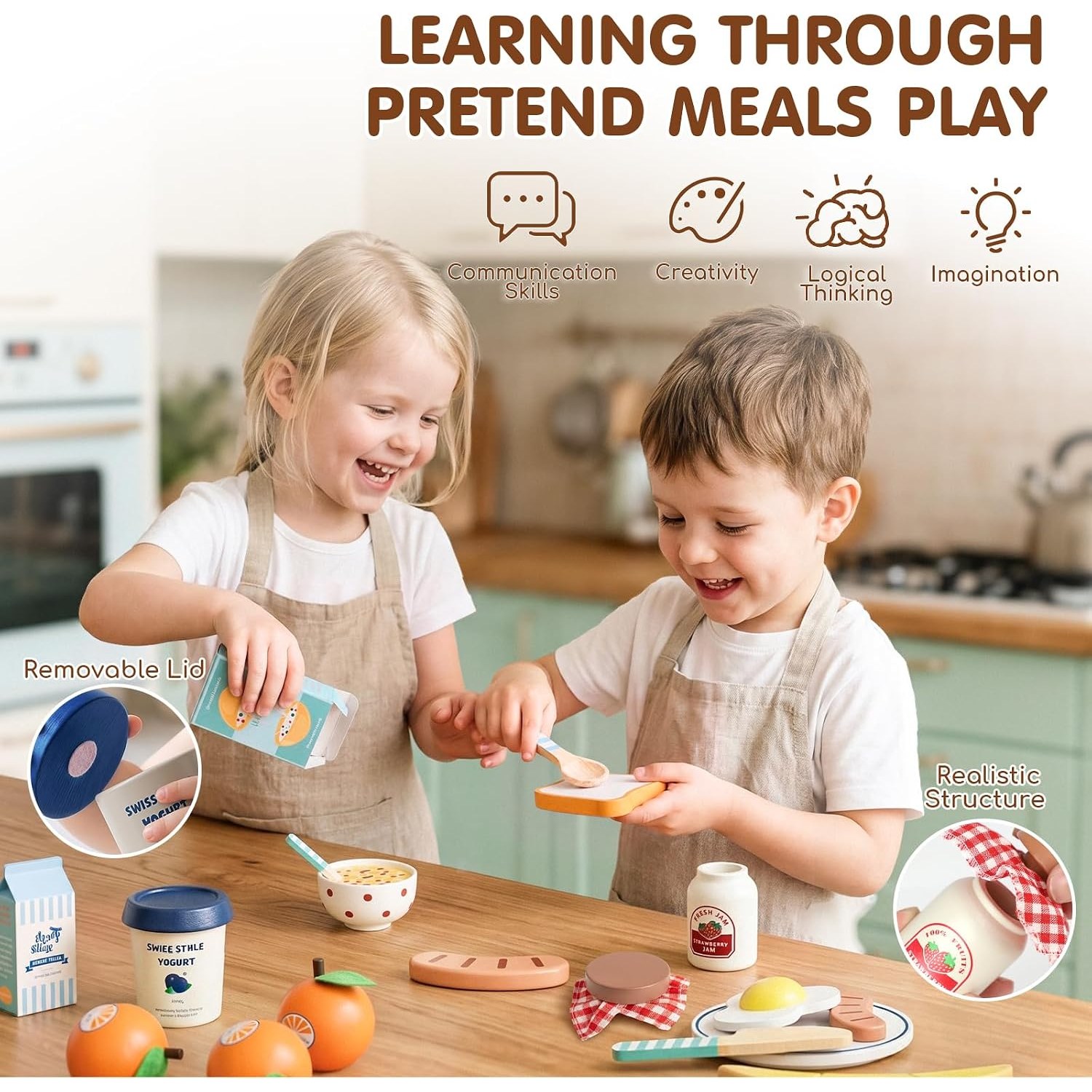
This set lists its educational aims as cognitive skill, communication skill, hand-eye coordination, role play and shape recognition. Those are not marketing words invented after the fact. They are what you will see if you sit and watch for ten minutes.
Who this suits
The manufacturer recommends 36 months to 5 years. That is a sensible window. Around three, most children move from simple object play to genuine storytelling, where the toy becomes a character in a situation rather than just a thing to hold. A cafe, a hotel breakfast, a sick teddy who needs toast, these are the kinds of scenes that start appearing.
It suits a child who already has a play kitchen and needs something to put in it. It also suits a child who has no kitchen at all, since the plate, bowl, knife and spoon make the set self-contained on a rug or a low table.
It is a good pick for households that want fewer noisy toys. Nothing here has batteries. The only sounds come from the pieces themselves, which is part of what makes it one of the better screen free toys for preschoolers in a house that already hums with electronics.
It is less suited to a child under three who still puts toys in their mouth, because of the smaller items like the spoon and the oranges. It is also not the right choice if you want a single showpiece toy. This is a set of many parts, and many parts means occasional hunting under the sofa.
What is in the box
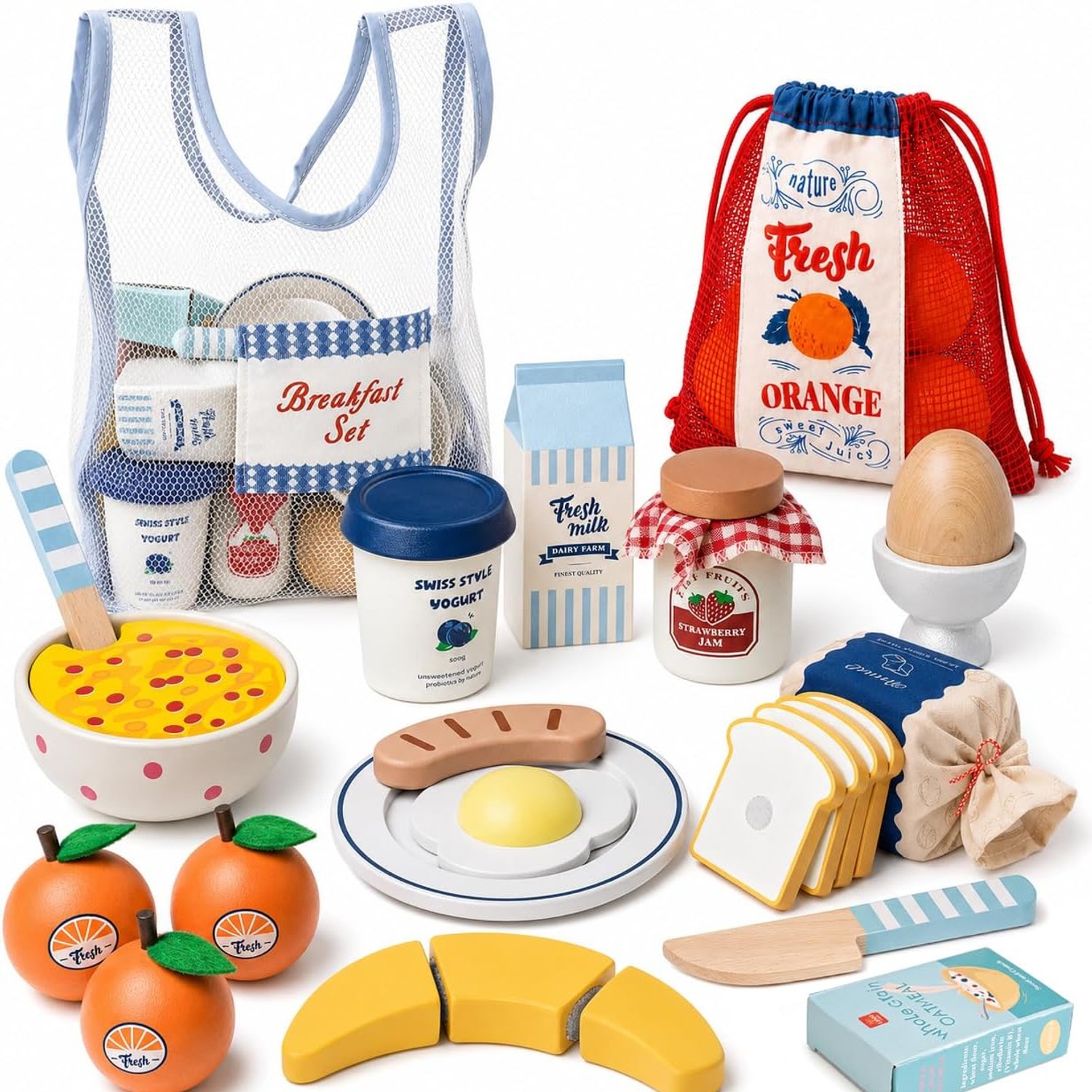
The list runs to around 25 pieces. On the food side there is an egg with a tray, a fried egg, a sausage, milk, yogurt, a banana, three oranges, an oatmeal box with oatmeal and strawberry sauce, and six slices of toast. On the serving side there is a plate, a bowl, a knife and a spoon.
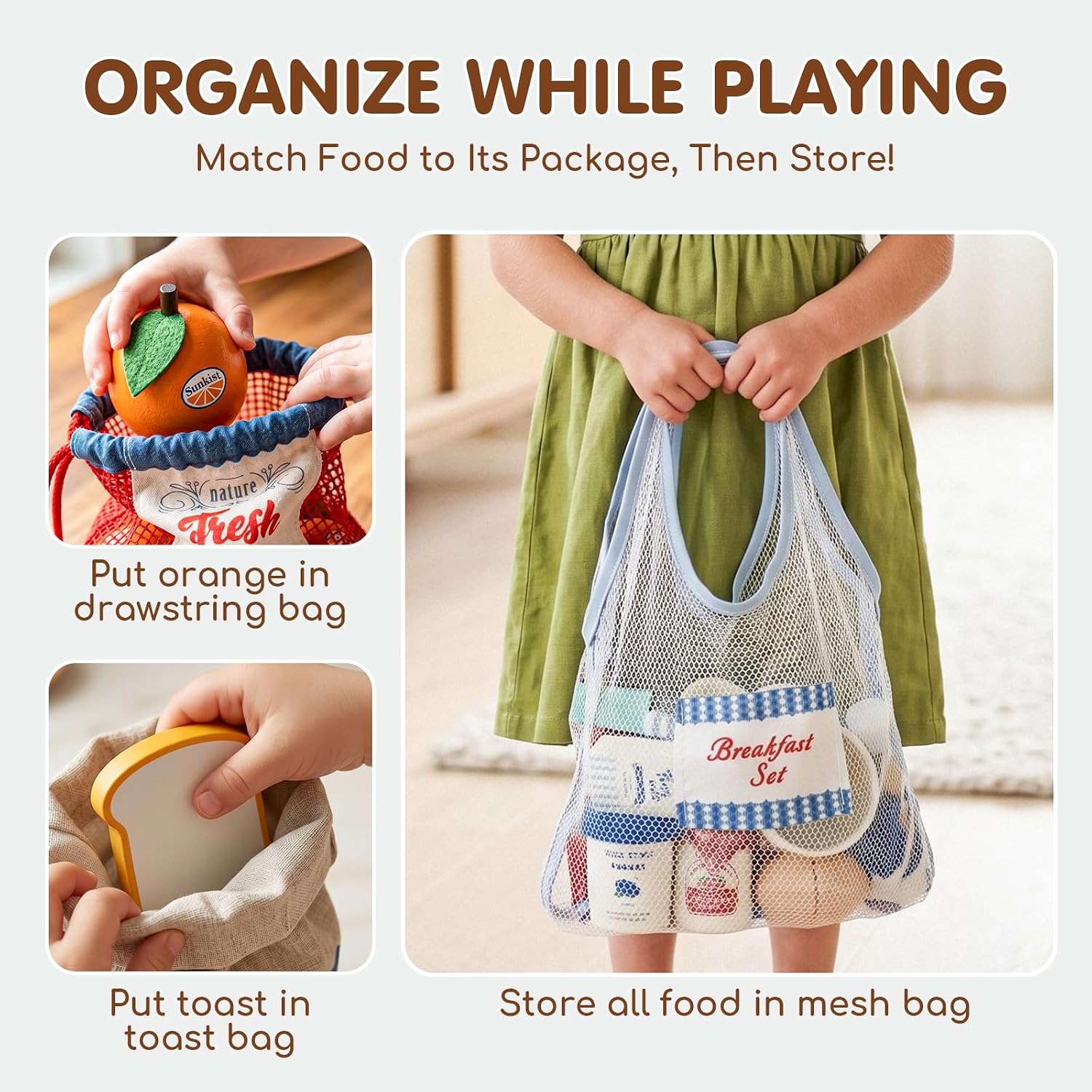
Then there are the bags, and these matter more than people expect. A toast bag, a fruit bag and a breakfast bag mean every group of items has somewhere to live. Instead of one tub where everything mixes, you get sorting built into the pack-up. Children who will not tidy a pile will often happily put the oranges in the orange bag, because that is a task with an obvious answer.
The whole thing measures 8.66 by 7.48 by 3.54 inches and weighs 1.9 pounds, which is about 0.86 kg. That is small enough to go in a bag for a weekend away. A set that travels well gets used far more than one that only lives on a shelf.
How to choose between play food sets
A few questions sort most of it out.
First, does the set tell a story? A themed set beats an assorted one for the reasons above. Breakfast is a particularly strong theme because it is the meal small children are most involved in.
Second, can anything be cut, opened or stirred? Static food gets picked up, looked at and put down. Food that changes state gets used. The best wooden cutting food toy options give a child something to actually do.
Third, is there a way to put it away? Sets with bags or boxes survive in family homes. Sets without them end up scattered, then bagged in a carrier bag, then forgotten in a closet.
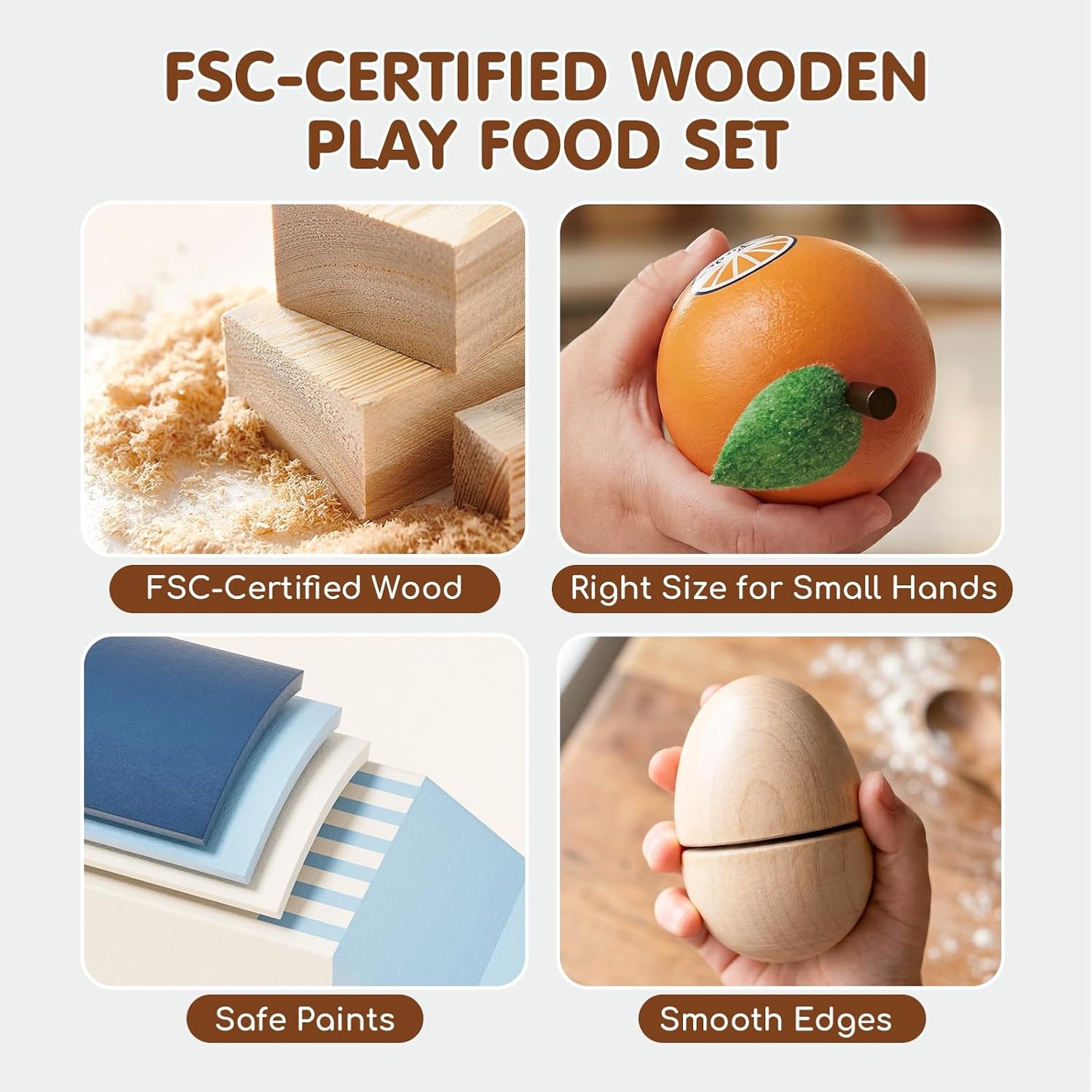
Fourth, is the material one you are happy with? Wooden pieces have a weight and a sound that plastic does not, and most people find they age better. The trade-off is that wood cannot be scrubbed under a tap.
Fifth, does the age rating match your child right now, not in a year? A set that is too advanced sits unused, and by the time they grow into it the novelty has gone.
Looking after it
Wood is easy to care for as long as you never soak it. Wipe the pieces with a slightly damp cloth and dry them straight after. Skip the dishwasher entirely, because heat and standing water will lift finishes and can warp smaller parts.
The fabric bags can be spot cleaned by hand with a little mild soap and cool water. Let them dry fully in the air before you refill them, and keep them away from radiators while they dry.
Store the set in its own bags rather than tipping it into a general toy box. Pieces stay together, nothing gets crushed, and the next play session starts with a complete kitchen instead of a treasure hunt. Every so often, have a quick look over the pieces for chips or loose joins and retire anything that has had a rough life.
Getting more out of it
A few ideas that cost nothing. Place an order and make it specific, two toast and one orange, so your child has to count and listen. Run a cafe where you pay with buttons or bottle caps. Give a teddy a food allergy and see how your child adapts the menu. Ask them to make a breakfast using only yellow things.
These small prompts stretch the same set much further than it would go on its own. They also do most of the work people hope the best pretend play food for preschoolers will do, which is get language and thinking moving.
The short version
This is a wooden breakfast play food set built around a scene a preschooler already understands. Around 25 pieces covering toast, eggs, fruit, oatmeal and drinks, plus a plate, bowl, knife and spoon, plus three fabric bags for storage. Material type is wood, model FT-005 from Lehoo Castle, and the recommended age is 36 months to 5 years.
It suits a preschooler past the mouthing stage who likes acting out real life. It gives practice in cutting, sorting, counting and conversation without a single battery. And because it packs into its own bags at about 0.86 kg, it is one of the few toy sets that actually goes where the family goes.