
The complete guide
Choosing a Stunt RC Car for Kids, A Practical Buyer's Guide
The problem with most first remote control cars
Buy a child their first RC car and you will probably watch the same thing happen. The car tears off across the lounge, hits a chair leg, rolls onto its roof, and then nothing. The child looks at the car. The car does not move. An adult gets up, walks over, flips it, walks back, sits down. Thirty seconds later it happens again.
That cycle is why a lot of remote control cars end up at the back of a closet by week three. The toy is fine. The design just does not survive contact with how children actually play, which is fast, enthusiastic and not very careful.
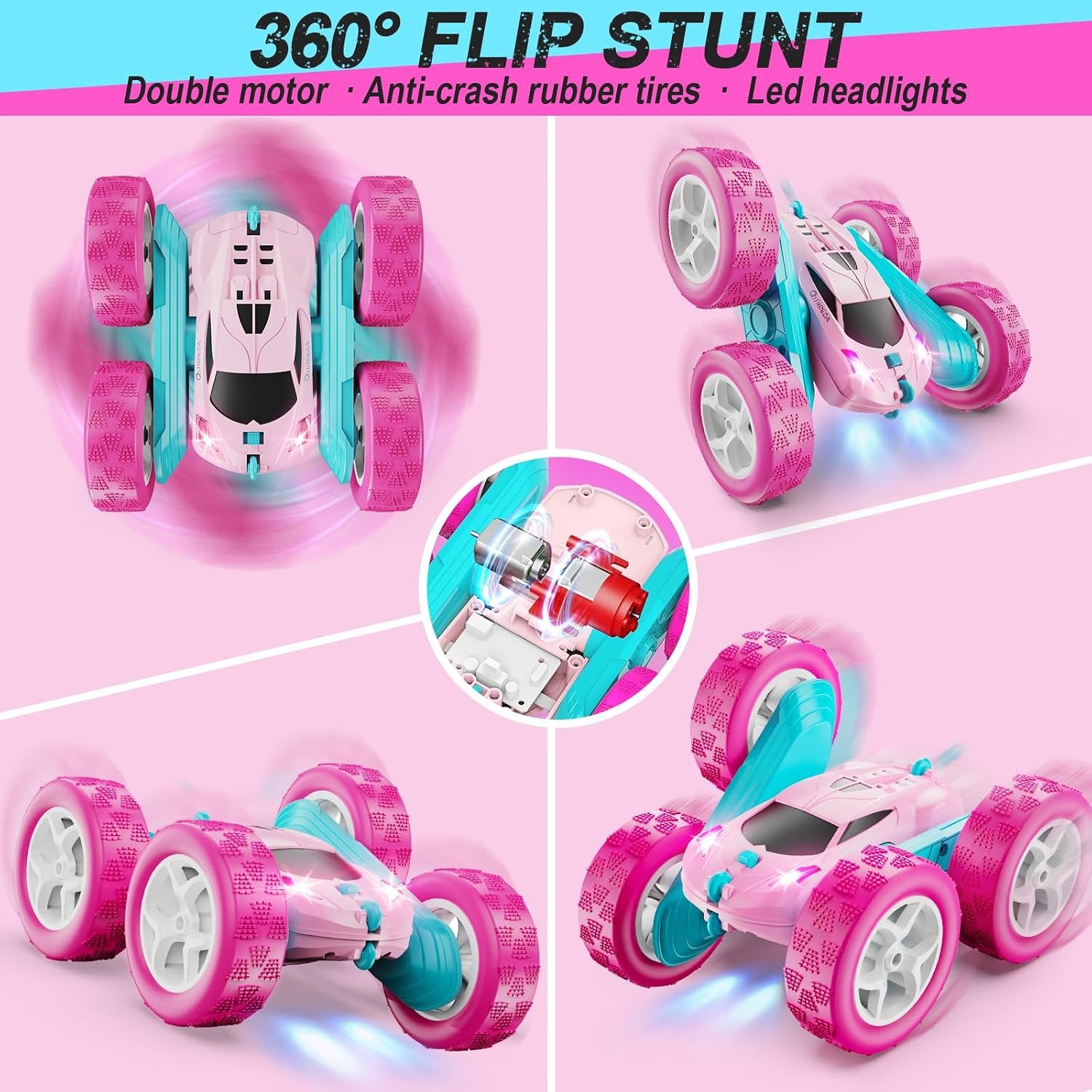
A double sided stunt car solves it by removing the concept of upside down. The body is built symmetrically, so the wheels work the same whether the car lands on its roof or its base. A crash becomes part of the game instead of a pause in it. If you are hunting for the best rc car for 6 year olds, that single feature probably matters more than top speed or brand.
How this car actually works
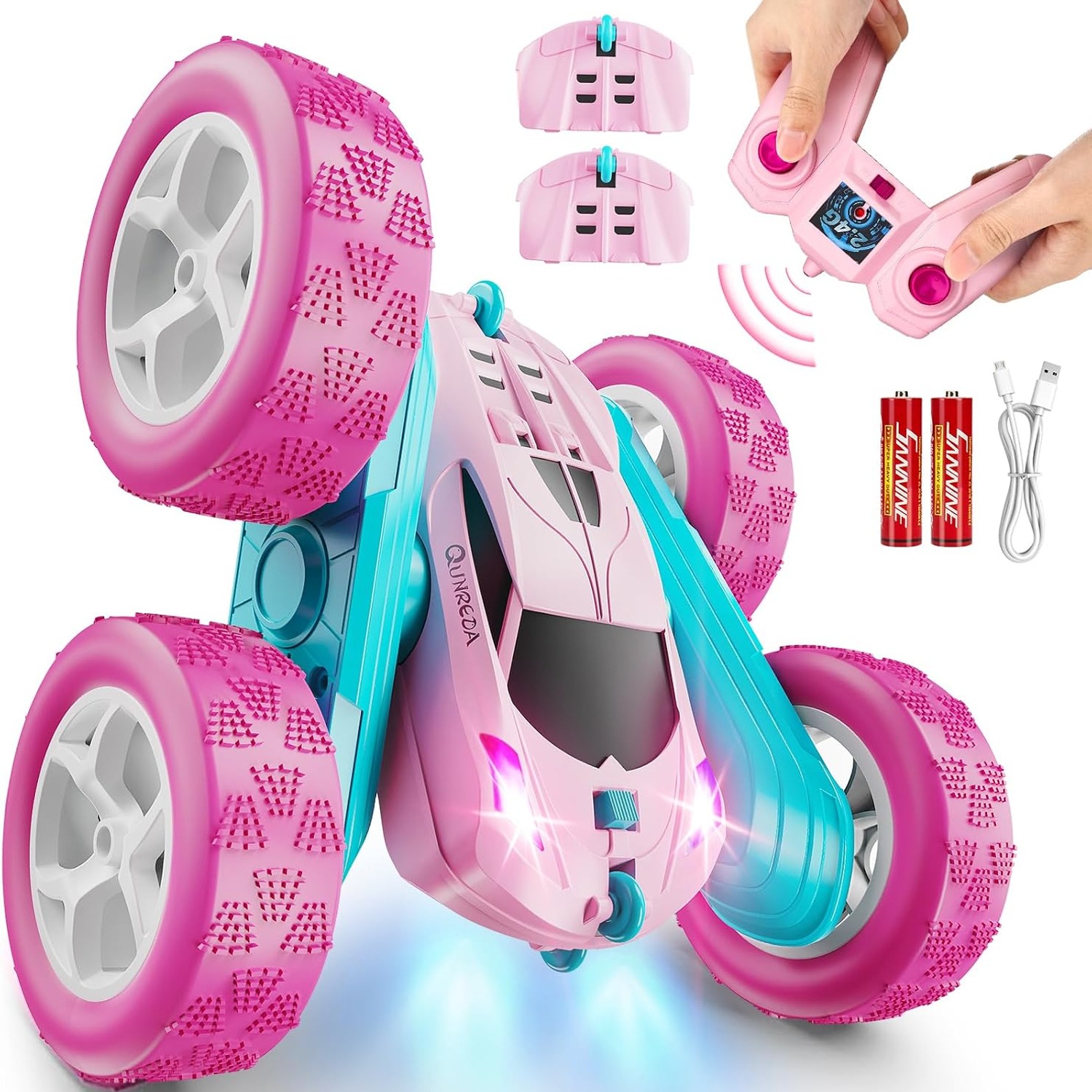
The QUNREDA Q1 is a compact car, 6.3 inches square and 2.8 inches tall, weighing half a kilo. Top speed is quoted at 10 km/h. That number sounds modest written down, but on a kitchen floor or a patio it is plenty. Small cars feel faster than big ones because the scale makes everything look quicker.
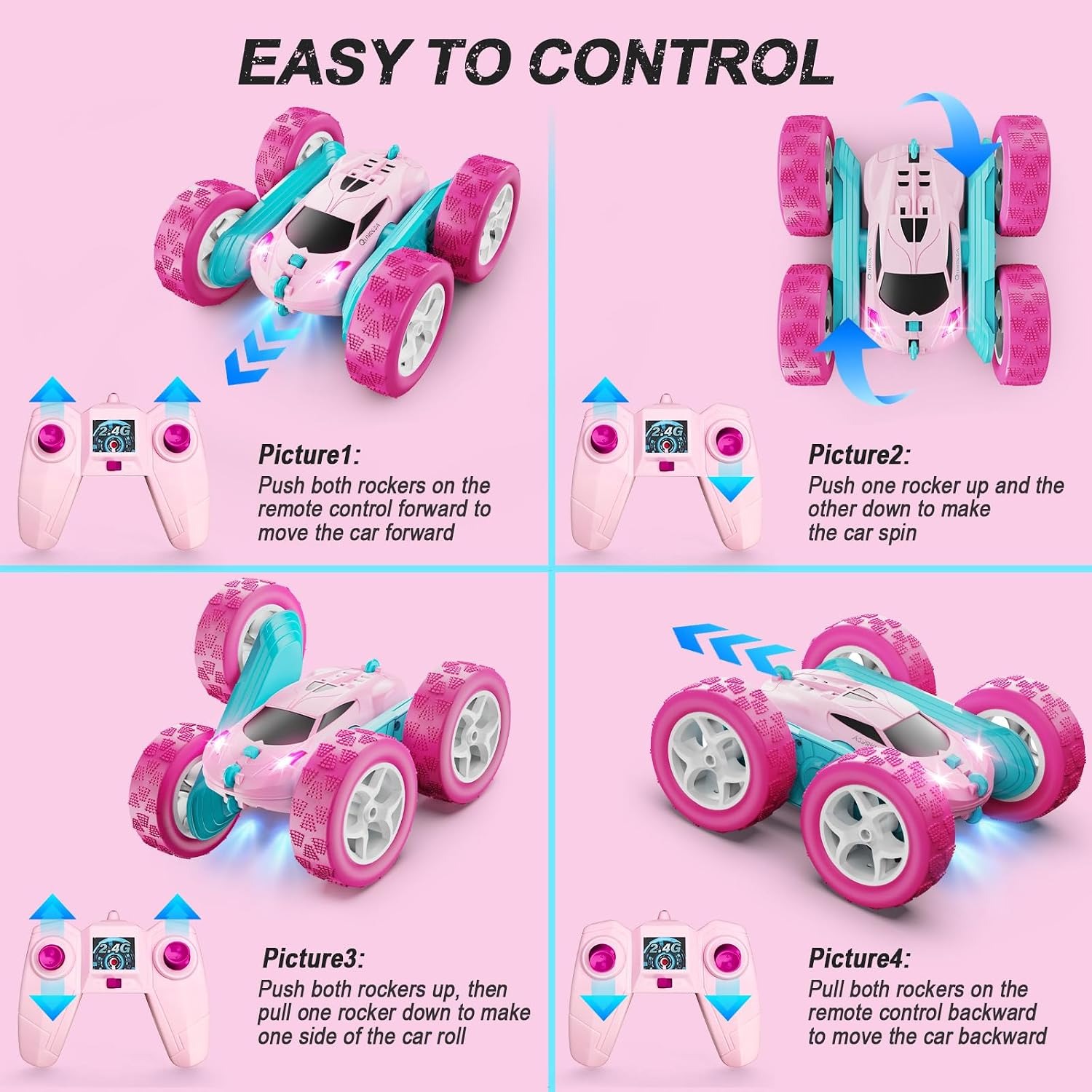
Control comes through a 2.4GHz radio link with a range of up to 50 meters. The handset has two buttons. That is it. Those two buttons, used in different combinations as described in the manual, produce nine distinct stunt moves. Forward and reverse are the obvious ones. Then there are clockwise and anticlockwise spins on the spot, 360 degree rotations while the car is double-sided and rolling, and tumbling flips performed mid-run.
The limited button count is a deliberate choice and a good one. A handset covered in triggers and toggles looks impressive in a photo and confuses a six-year-old in practice. Two buttons means a child can be doing real stunts inside five minutes, which is when a toy earns its place.
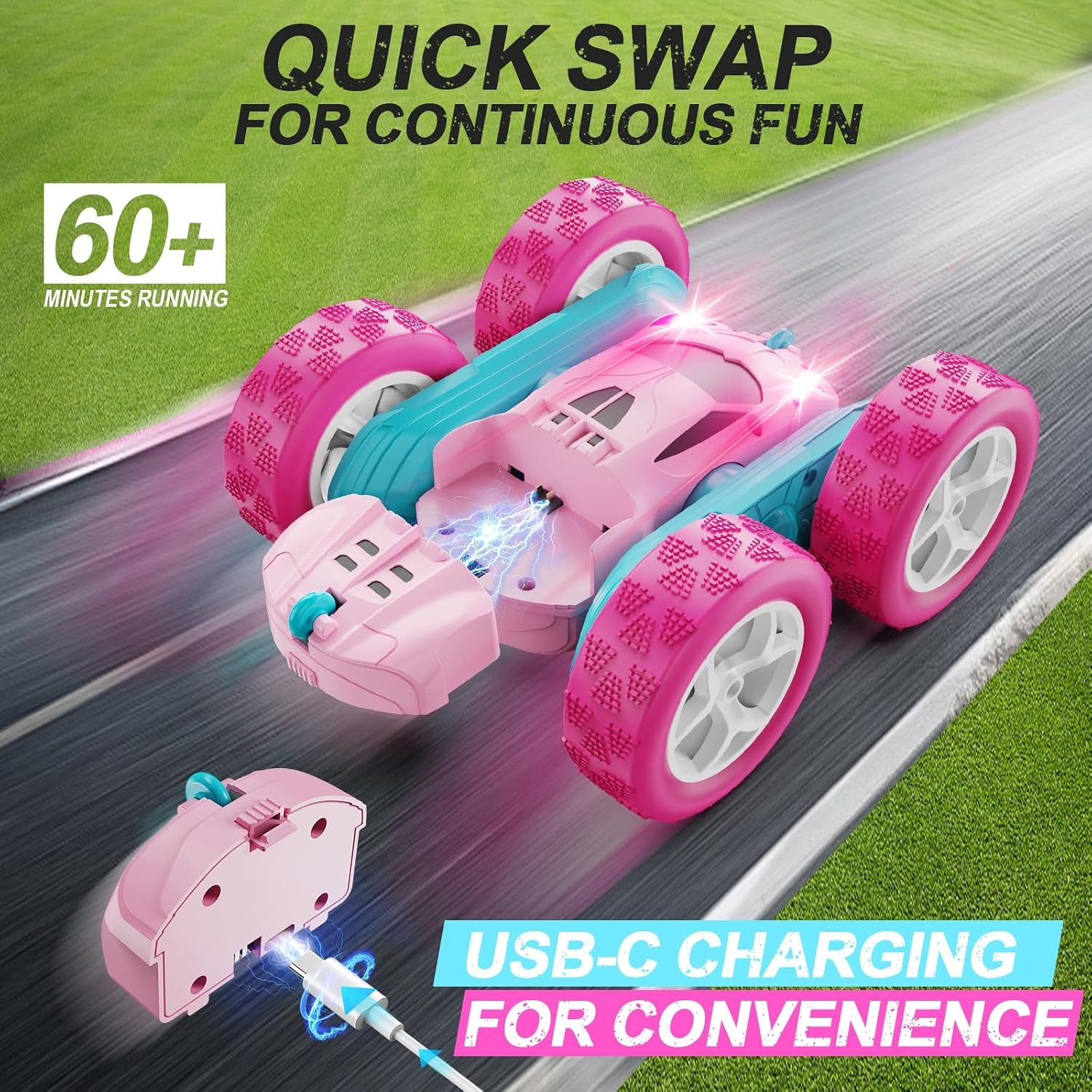
Power comes from two detachable lithium-ion battery modules. One is already inside the car, under a molded ABS cover that sits flush with the body. The second lives in the box. Each gives around 25 minutes of running time, so the pair covers roughly 50 minutes. When the first one dies, you pull it out, slot the spare in and keep going while the flat one charges from the supplied cable.
That detachable design matters for two reasons. First, charging happens away from the car, so there is no trailing cable attached to a toy a child wants to pick up. Second, it kills the single biggest frustration with rechargeable toys, which is a flat battery and an hour of waiting.
Who it suits
The manufacturer's guidance is 6 years and up, and that feels about right. At six, a child has the coordination to steer something that moves this quickly and the patience to practice a flip until it works. Below that, the car will still entertain, but an adult will be doing a lot of the driving.
At the upper end, there is no hard ceiling. Nine- and ten-year-olds get into timing the double rotations and building obstacle courses out of books and cushions. The interest tends to fade when a child starts wanting proportional steering and hobby-grade speed, which is a different and far more expensive category.
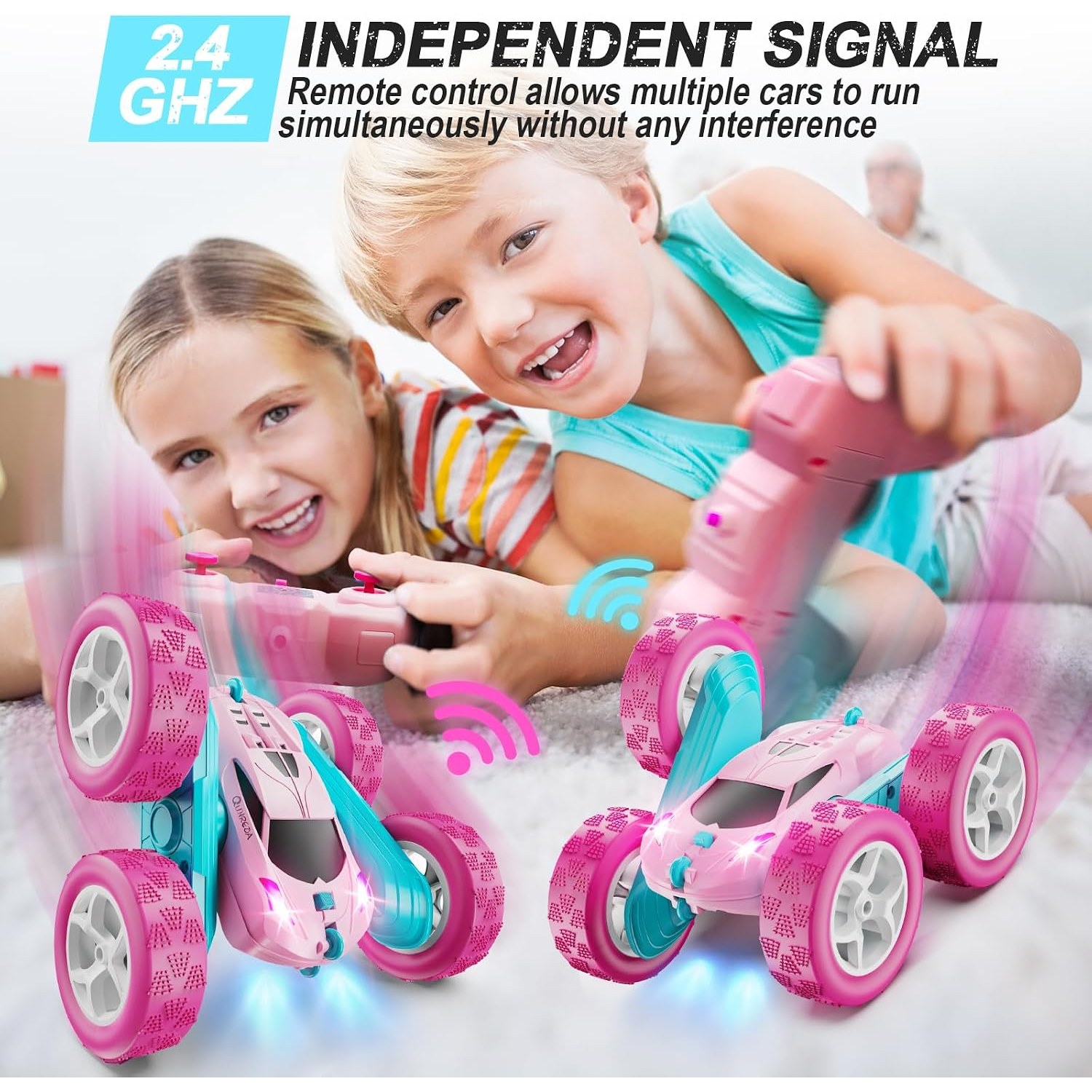
It is a one-player car with one handset. If you have two children who will both want a go, the honest answer is to buy two. The 2.4GHz anti-interference system exists precisely so that several of these can run in the same space without the signals tangling. Two cars in a garden turns into a race, and a race lasts a lot longer than taking turns.
The pink finish and the stunt focus make it a common pick when people search for the best pink remote control car, though nothing about the car is restricted to one kind of child. The red LED headlights at the front are more than decoration. When the car is twenty meters away and has just finished a spin, those lights tell you instantly which end is the front, and that stops a lot of accidental reversing into fences.
Where you can drive it
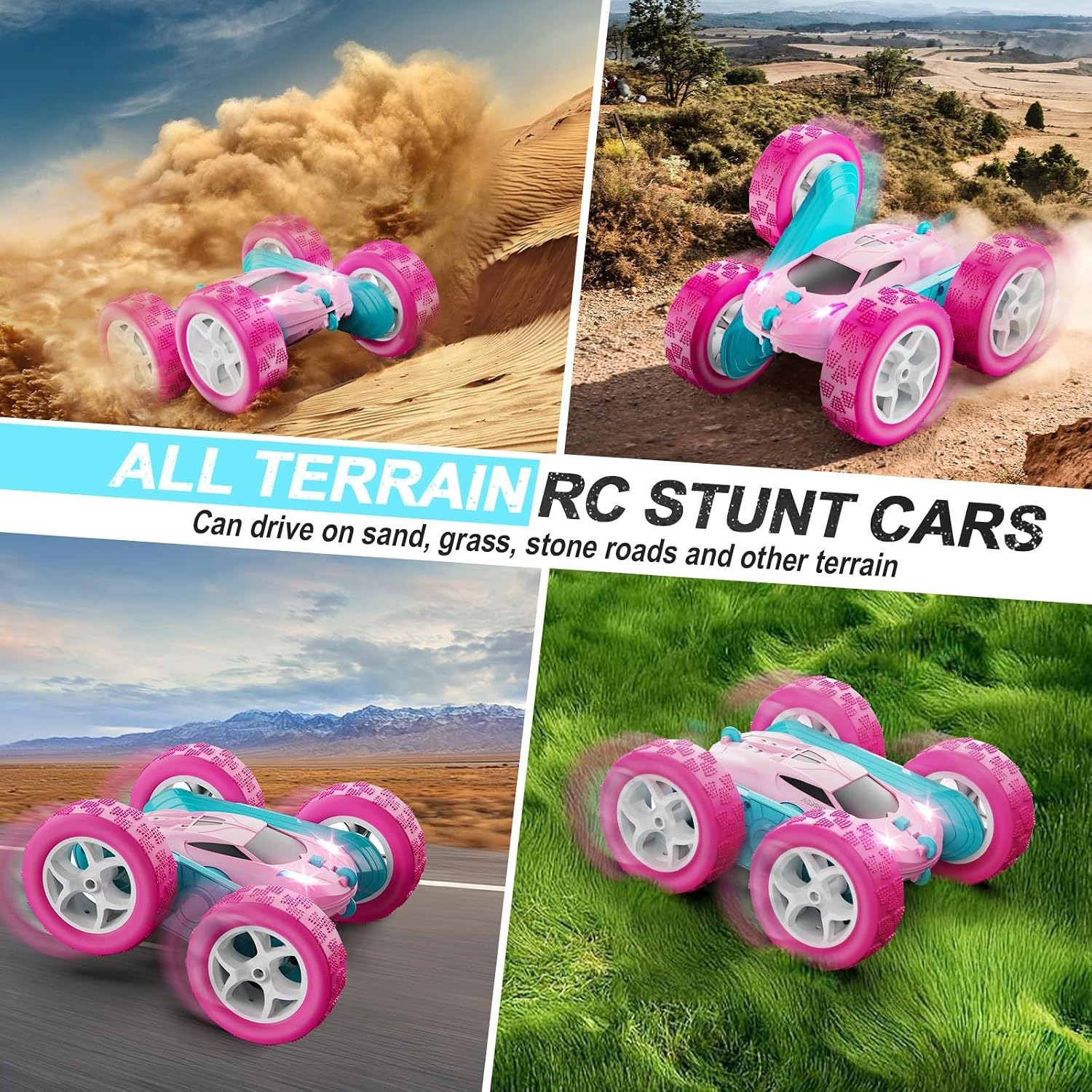
The tires are a softer ABS than the body, which gives a bit of flex on impact and reasonable grip. The manufacturer lists sandy beach, wetlands and grassland alongside indoor use.
In practice, hard surfaces give the best stunt performance. A patio, decking, a garage floor, a hallway with floorboards or tiles. On these the car spins cleanly and lands flips properly. Short grass works well too. Thick lawn and shaggy carpet both slow it down and make full rotations harder to complete.
One thing to be clear about. This is not a waterproof car. The tires handle damp ground and the body shrugs off splashes of sand, but puddles, streams and heavy rain are a bad idea with any battery-powered toy of this type. Keep it on the dry side of wet and you will have no trouble.
After outdoor play, give it thirty seconds of attention. A dry cloth over the body, a quick check around the wheels and axles for grit, sand or wrapped hair. Those small particles are what kills cheap RC cars over a season, not the crashes.
What to look at when comparing cars
If you are weighing this up against other options, four things are worth checking on any listing.
Battery arrangement. Ask whether the car is rechargeable, how long a charge lasts, and whether a spare is included. A car with one sealed 20-minute battery and a 90-minute charge time will disappoint. Two swappable modules is the better arrangement.
Recovery from crashes. Either the car is double-sided, or it has a self-righting mechanism, or someone is going to be flipping it over all afternoon. For a young child this is the deciding factor.
Control frequency. 2.4GHz with anti-interference is the standard to look for. Older 27MHz systems clash with each other, which rules out racing and causes random behavior when a neighbor's car is running.
What is actually in the box. Some listings quote a low price and then need AA batteries for the handset, a charger, or both. Here the two AAs, the charging cable and a screwdriver are all supplied, so the car works the moment it is unwrapped. On a birthday morning that is worth something.
Keeping it running
Store the car somewhere dry, out of direct heat and away from a sunny windowsill. If it will not be used for a few weeks, take the battery modules out of the car and the AA batteries out of the remote. Batteries left sitting in unused toys are a common cause of corrosion.
Charge the modules fully before each session rather than topping them up in short bursts. Supervise charging, as you would with any lithium-ion device, and unplug once done.
Clean the wheel area regularly. A cocktail stick or the corner of a cloth is enough to pull out hair and grit from the axles. If the car starts pulling to one side or sounding rougher than usual, that is almost always the cause.
The short version
This is a pink RC stunt car built around one sensible idea, which is that a car that drives upside down never needs rescuing. Add a two-button handset that delivers nine stunt moves, two swappable rechargeable batteries giving about 50 minutes of play, 2.4GHz control to 50 meters and tires that cope with grass and sand, and you have a toy that holds a child's attention past the first week.
It suits ages 6 and up, works indoors and out, and arrives with everything needed including the remote's AA batteries. If you want a straightforward first stunt car that survives real play rather than careful play, this one does the job.